Saturday, July 07, 2007

What is a safe withdrawal rate?

It has been a while since I posted anything. My life has been in some turmoil the last 30 days. We have moved into a new home. It has been complicated by a wife with a broken leg and two children under 4 years old. Getting anything done during this season of life seems to move in slow motion.

But things are settling down, so I am looking forward to blogging again. This post will be rather short.

I just lost a client because I had told her that a safe withdrawal rate in retirement is 4%. In other words, you can feel reasonably confident that you will be able to live on your savings the rest of your life if you limit your withdrawals to 4% of principal.

This is not what she wanted to hear. So she went out and found someone who would promise her a higher withdrawal rate. She found that person. She was told that she could withdraw 8% and have no worries about running out of money.

There are plenty of "planners" who will tell people 8%. I like Dave Ramsey and think no one does a better job of motivating people to get out of debt. But Dave also teaches that you can withdraw 8% from your retirement savings. It's crazy talk and here are two reasons it is crazy.

1. To take an 8% withdrawal you will need to invest with a heavy emphasis on growth investments. Growth investments have averaged 8-12% per year over long periods of time. But it is never a smooth 8-12%. There are periods where you will have to absorb significant losses in order to get the high average returns.

If you invested your money in 1969 and withdrew 8% a year. You would have run out of money in 1981 (right before the bull market raged from 1982-1999). There are many other periods we can point to.

2. High expectations presume on tomorrow. For all we know, 4% may be a poor assumption. We could see periods of bad economic times that will blow away all of our best laid plans. But 4% has some historical prudence behind it. 8% is presuming that you will be withdrawing money during very good economic times. You will need a solid bull market to support this rate of withdrawal.

There is a story Jesus told in the Sermon on the Mount about a wise man who built his house on a rock. A foolish man built his house on the sand. The storms came to both men. One of the houses was able to withstand the storm. One house was destroyed by the storm. Although Jesus was not making any comments on wise financial planning here (Matthew 7:24-27), the lesson endures.

It is wise to expect storms and be prepared. Err on the side of conservative assumptions. It will allow you to sleep better at night.

For God's Glory,

Ashley Hodge

Saturday, June 09, 2007

The Secret

Have you heard about the best-selling book and DVD series called The Secret? It has sold over 2 million copies by explaining that the secret to life is the law of attraction. You become what you think about.

I heard Oprah Winfrey say that this was true, so I thought I would give it a try. Good things happen to people who think only good thoughts. Bad things happen to people who think bad thoughts. If you have a disease, trial, disappointing relationship, etc... it has come as a direct result of your thinking.

Hmmm! Sounds interesting. I tried it on a couple of life events. I am tired of getting up every 3 hours to change my baby girl's diaper and give her to my wife to feed. So I tried to think positive about her sleeping through the night. It didn't happen. I also tried this week to think that the stock market would go up every day and create great wealth for my clients and self. But it lost value. Is the universe against me?

I am all for positive thinking. I enjoy being around positive people. I don't like to hear constant complainers. But there is a problem with the Secret. It doesn't work. I mean it might "work" for some people. But is something true, if it doesn't work for all people all of the time? You can think nice thoughts all day long. But you will die. You can think every day will be sunny. But one day it is going to rain. And it might rain hard.

It is has been raining hard for my family lately. My wife got diagnosed with a neurological disease called Charcot-Marie-Tooth about 3 years ago. Her muscles are wasting away because her nerves are not working properly. And there is no current cure. The Secret can't help her.

On top of that, she had a spinal cord tumor 2 years ago that we feared was cancerous and deadly. Praise God it wasn't but she had to have surgery to remove it and this tumor may reappear over and over again with more surgeries to come.

Despite these health trials, God continues to sustain and bless us. We have 2 healthy children. We sold a house in Dallas and we are building a home that was supposed to be completed in March of this year. We don't deserve it. But we are grateful.

Because our house wasn't ready, we had to move our selves and kids to live with my wife's parents for a few weeks. Not being in your own bed is a little inconvenient, but no big deal. But building a house is stressful- lots of things go wrong. Not the kind of stress that comes from not knowing where your next meal is coming from. Or the stress that comes from being in continual pain. But stressful nonetheless. I guess if I lived in the world of The Secret, the new house would have been completed on time.

Life was difficult enough with the new home; a 7-week old baby; a 3-year old; my wife's ongoing health concerns, etc... But then she fractured her leg last week. She did this in Joe Theismann like fashion. She was screaming as I rushed to her. I saw her ankle hanging to the side. In a panic, I reset her ankle which caused her extreme pain.

I don't know why I did this. I have to credit God's Spirit. I know it wasn't The Secret. But it ended up being the right thing. The surgeon told me that it might have saved her leg. If the ankle hadn't been reset, she could have had a broken blood vessel or major nerve damage. I am sitting with her in the hospital right now as she recovers from surgery. She will be wheelchair bound for 3 months. I don't look forward to it- I have to be honest. It is a whipping.

I guess you could say that we are living the anti-Secret right now. But God is enough. He sustains us through every trial. He is our joy. We don't need good health to be thankful. We don't need stuff- although God has given us an abundance. This is the message that must be communicated to the world. God is not a slot machine. Jesus is not the ticket to prosperity.

Jesus invites us to come to Him and die, "If anyone wants to follow me, let him take up his cross and follow Me. For whoever would save his life will lose it, but whoever loses his life for My sake will save it."- Luke 9:23-24. Sound attractive? Not to the Secret followers.

But Heaven can wait. I believe in the Secret in this sense. God will have abundance in store for those who yield to Him and follow Him. He will make good on His promises when He eliminates sin, disease, war, evil, pollution, etc... He will give His children a perfectly renovated earth in a resurrected body. He gives us a taste of this goodness during this life. But to really experience this, we must die. This life is not heaven. There are problems. But one day all wrongs will be made right.

The Apostle Paul told us, "To live as Christ and to die is gain."- Philippians 1:21. There is no secret to that. The gospel is believing God's promises of eternal bliss. But is also a willingness to travel a hard road to get there. A faith that costs nothing is worth nothing. Jesus told his disciples, "I told you these things that you may have peace. In this world, you will have tribulation. But take heart; I have overcome the world."- John 16:33.

Life is full of trials. Thinking them away won't do anything to help us avoid them. But God gives us grace to handle them one day at a time.

For His Glory,

Ashley Hodge

Saturday, June 02, 2007

Grace Giving- Traveling Light

One of my financial planner friends- Michael- encouraged me to balance my attack on tithing with a picture of what grace giving should look like under the new covenant of Christ.

I agreed that this was a good idea and this post is my attempt to do so. Let me start off by saying that one of the dangers of taking a stand on something is that people will view you as a hypocrite when your life doesn't match your beliefs.

For example, Al Gore speaks about the need for environmental reform. But he spent over $30k on electricity and natural gas in 2006 in his 10,000 square foot home. This makes him an easy target for critics that he is unwilling to make necessary sacrifices to be environmentally friendly.

In that sense, I admit that I am a hypocrite. The ideals that I espouse are goals that I strive for but fall short of. I am painfully aware that I could consume less than I do. I eat too much. Live in a house that is more than I need. I have more stuff than I need. I buy things and then days later ask, "Why did I do that?" I am not as conscious about waste as I should be. I give less than I could if I was willing to make more sacrifices, etc...


I am aware of my faults and try to make improvements as I journey through this life. My heroes are those who are content with less and view money and possessions as something to be funneled to others in need. I love what the English pastor John Stott said, "We should travel light and simply. Our enemy is not possessions, but excess."


In a nutshell, this is what I believe about grace giving under the new covenant. Possessions and things are gifts from God. Everything that God has created is good. We are to enjoy natural beauty and the improvements on creation that have come through the cultivation/innovation of mankind who are instructed to be stewards of God's resources- Genesis 1:28. We are to enjoy these things with gratitude.

God has showered the US with great financial wealth and abundance. Have we done anything to deserve this? No. It is the outflow of God's mercy. Has this abundance come directly as a result of tithing to a local church? I believe the answer is no. God's common grace showers plenty of evil men and women with abundance also. This is why the prosperity gospel is false.

Tom Verace a pastor in Arlington said this in a recent sermon, "Sometimes we are selling popsicles in the midst of a heat wave." Our prosperity can be attributed to good economic times not a direct result of God owing us anything for our faithfulness.

So the question is: what should we do with the resources that God brings our way? I believe there are some key questions we need to ask ourselves:

1. How much do I need to live?

We should evaluate what is needed for our families. This should be a prayerful process. What is wrong for one family might be right for another. But the challenge should be towards getting rid of excess in every area of life. For me this has had some practical implications: dropping 40 lbs of excess body weight; building a house with a small yard; purging any possession that has not been put to use in the last 12 months.

A recent song by Switchfoot titled American Dream has these lyrics,

When success is equated with excess
The ambition for excess wrecks us
When the top of the mind becomes the bottom line
When success is equated with excess

I want out of this machine
It doesn't feel like freedom
This ain't my American dream
I want to live for bigger things

2. How much do I need to give, save and/or pay down debt?

Most Americans don't save enough. But some save too much. Too much money in the bank at the end of life can be as worthless as too many possessions. There should be a finish line for every Christian. Howard Dayton writes, "you don't see runners crossing a finish line of a race and continuing to run." Once we determine our Number, we should consider radical generosity with everything above this Number.

In other words, I believe that financial freedom is a worthwhile goal. We owe it to our spouses and kids to be striving for financial strength. Financial freedom allows us to use time and money in ways that are glorifying to God. When we are saddled by debt or financial worries, there is a tendency to make decisions that are less than ideal.

Debt should be attacked aggressively. Wise King Solomon said, "...you know not what disaster may happen..."- Eclessiastes 11:2. Being completely debt-free is wise. But being debt-free on a 8000 square foot home is different than being debt-free on a 2000 square foot home. Are you really free if your lifestyle requires massive overhead each month just to break even?

I believe that giving is a discipline. I am always in favor for setting giving goals each month/year and stretching towards those goals. But as I have written before, I just don't see the scriptural argument towards saying that 10% of your income must be given to a local church.

Everything we own or will own belongs to God. I have never earned a dollar that is not the direct result of God's grace. He can take my breath away any moment He desires. He can strip me of materials and abundance in a second and I will have no basis for complaint about God's unfairness in doing so.

But if He chooses to bring resources my way, my responsibility is to view every dollar and decision as part of a sacred trust. I am His steward. Whether I spend, give, save or pay off debt; I am to do all things for the glory of God.

Naturally the steward's heart will want to give generously. My desire is that Christ would increase and I would decrease- John 3:30. What this means to me is that I should strive for moderation and strategic simplicity in the way I live. And if my income rises, I should give a greater percentage each year. I don't believe the percentage matters. God sees the heart and he sees through all the ways we try to justify our goodness and faithfulness.

For His Glory,

Ashley Hodge


Sunday, May 20, 2007

Tithing- A Twisted Teaching?

If you attend a Christian fellowship long enough, you are likely to hear many sermons on the subject of tithing. Sometimes the sermons are called something different like "Biblical Stewardship" or "God's Plan for Your Finances". But the message is usually the same: you are required to give a tenth of your finances to the local church if you want God to bless you. If you don't tithe (give 10% of your gross income), you will be under the curses of God and things will not go well for you.

For most of my life I believed this to be true. I had many well-respected pastors and Christian writers reinforce this idea in many creative ways. The popular texts to "support" this view are: Malachi 3:8-10; Matthew 23:23 and a multitude of old covenant laws- Leviticus, Deuteronomy.

I decided to study the topic in detail in 1999. I read over 20 books on the subject- many written from a pro-tithing view. Some written from an anti-tithing view. Let me clarify. I believe that most Christians- myself included- would applaud anyone who gives 10% or more of the income that God has provided for the purpose of meeting real tangible financial needs to spread the gospel of Christ. When I say pro-tithing, I mean that an author expouses a belief that giving 10% of one's income is mandated today. Anti-tithing simply means that the author believes this requirement is no longer valid.

There are huge problems with the way tithing is taught in a large percentage of congregations. The give-to-get philosophy is rampant. The law of attraction nonsense that has inspired the best-selling book The Secret is all too prevalent in Christendom. But I will assume for arguments sake that pro-tithing teachers have no ulterior motives for espousing this doctrine.

The question becomes: should tithing be taught as a principle that applies to Christians today? I believe the answer to this question is "no". Why do I believe this? I have five major reasons:

1. The Word of God does not teach tithing as a principle for believers in Jesus Christ. There are some Old Testament verses that teach the importance of tithing. These verses can be easily manipulated to formulate a belief in tithing for Christians today. But Israel was under a theocracy. God was their Ruler. Tithes were taxes paid to priests who administered the laws of God. We do not live under this form of government. God is still our Ruler. But we now pay taxes to the governments that He has installed to rule us- Romans 13:1.

John MacArthur is a well-respected Bible teacher. He explains this in an answer to the question: does God require me to give a tithe of all I earn? I whole-heartedly agree with his response: http://www.biblebb.com/files/macqa/IA-tithe.htm

2. Tithing diminishes the joy from giving. No one joyfully pays taxes. At least I don't. I suppose there are people out there who love to give 10% of their income to their local church because their pastor has convinced them that there are God-ordained goodies in store for them as a result of their faithfulness. But the New Testament clearly teaches that giving should be cheerful and not under compulsion. 2 Corinthinans 9:7 teaches, "Each one must give as he has decided in his heart, not reluctantly or under compulsion, for God loves a cheerful giver."

My conviction is that the amount of money and where that money is disbursed should be continually motivated by God's Spirit. We should support the poor and needy; proclamation of the gospel and people/ministries that are discipling us. We are not required to finance massive building campaigns and cushy lifestyles for ministry professionals.

3. Tithing is counter-productive to the clear biblical message of whole-life stewardship. A Christian believes in Christ and submits to Him in every area of life. God now owns 100% of our money, ability, time and health. There is no separation of sacred and secular to the committed believer. The Christian should prayerfully decide how to allocate every resource. In the case of money, we should work hard to obtain honest wealth. But here is where it gets tricky.

Does it honor God to charge your customer twice as much so that you can give more to your local church? Is it really more spiritual to give money to your local church than to provide for your family; help a person in need; pay off debt or save? Common sense tells us that there are plenty of dilemmas that cannot be solved by some black and white rule. We should daily seek the Holy Spirit's guidance on how to distribute the resources God entrusts to us.

4. Tithing is inequitable. Many pastors teach that you are required to give 10% of your gross income to the local church. For the Ed Young Jr's; TD Jakes; Kenneth Copeland's of the world this is easy to teach. If you are making over $1,000,000 per year, you can spare $100k without much of a problem. But what about the single mom of three kids who is scraping by on $30k per year. Is it fair to require her to give $3k per year to the local church?

Shouldn't we ponder Andrew Murray's words: "How different our standard is from Christ. We ask how much a person gives? Christ asks how much a person keeps?"

The idea that all people should give 10% of their gross income to the local church reminds me of Jesus' stern warning to the Pharisees- religious leaders of Israel in Jesus' day. Luke 11:46, "Woe to you Pharisees! For you load people with burdens hard to bear, and you yourselves do not touch the burdens with one of your fingers."

5. Church history is noticeably silent on the topic of tithing. The teaching of tithing for believers has only come into vogue since 1900. Jesus only mentioned it once in the Gospels- Matthew 23:23- and this was not an endorsement of it for his followers. Paul never mentions the tithe. Nor does Peter, James or John. The author of Hebrews mentions the tithe but again only to illustrate a different theological point.

Martin Luther and John Calvin- two of the most voracious students of Scripture- did not teach tithing as applicable to the new covenant believer. Luther said this in a sermon dated August 27,1525: "But the other commandments of Moses, which are not (implanted in all men) by nature, the Gentiles do not hold. Nor do these pertain to the Gentiles, such as the tithe...

Early church leaders wrote the following comments in reference to the subject of tithing:

“The wealthy among us help the needy…As for the persons who are prosperous and are willing, they give what each thinks fit.” Justin Martyr, 160 A.D.

“Instead of the Law commanding the giving of tithes, He taught us to share all our possessions with the poor.” Irenaeus, 180 A.D.

“On the monthly day, if he likes, each puts in a small donation- but only if it is his pleasure and only if he is able. For there is no compulsion; all is voluntary.” Tertullian, 197 A.D.

Why is tithing taught in churches today? It's good business. The more a church takes in, the more financially secure and comfortable things are. But is it biblical? My conviction is no. Believe me it would be easier to say and think otherwise. The pro-tithers is a larger club. And they tend to take care of their own. They don't enjoy dissenting opinions.

But I have to stand on conviction. Perhaps God will show me different in Heaven. But I won't bet on it for the reasons I have stated above. Hopefully, all pro-tithers and anti-tithers can agree on this: all resources should be maximized for God's glory and the advancement of His kingdom.

For His Glory,

Ashley Hodge

Tuesday, May 15, 2007

Basketball and Stewardship

I love the game of basketball. I attempt to work into my schedule at least 3-4 hours of basketball every week. When it is just me, a basket and a ball, I often have my best thinking time. This is the time I come up with blog topics.

Yesterday, I started thinking about the link between basketball and a resurrected body.

Have you ever seen a really talented player who didn't understand the game and think: why did God distribute that kind of talent to someone who is wasting it? Likewise, I have played with guys who are fun to play with because they understand the team concept. But the skills are limited.

I look forward to a resurrected body and mind. I look forward to glorifying God by focusing passions without the hindrances and limitations of sin. I am excited about the potential pick-up basketball games in the new heavens and earth.

I started thinking about a pick-up game with a potential God Squad- guys who have made a public profession of faith in Christ and seem to have a demeanor that matches this profession. These names come to mind:

C- David Robinson
PF- Dwight Howard
SF- Dwayne Wade
SG- Pistol Pete Maravich
PG- Chris Paul

It would be a tough team. But I believe many ordinary Joes like myself will be able to compete and play on their level with a resurrected body and mind. I love basketball so much that there was a time in my life- before marriage to Amy- that I thought...

"I should just rent a simple apartment next to some good outdoor courts and an indoor gym. Then I could play pick-up basketball 4-5 times per week. And if I stay single... I could watch every college and NBA game that I want... And..."

Fortunately, I matured. But the longing for this has just been delayed to enjoying it fully in heaven. Now, I catch a glimpse from time to time. I understand Eric Liddel's line in Chariots of Fire, "God made me fast. And when I run, I feel His pleasure." God didn't make me a tremendous basketball player, but He did create in my heart a desire for the game. And when I play, I feel His pleasure.

In heaven, playing basketball and having time to read all the books I want to read are going to be permanent realities. I believe this. Because I believe heaven is the earth renovated. Our purest longings will be fulfilled as we enjoy the full presence of Christ and the elimination of the curse of sin. Psalms 107:9, "He satisfies the longing soul and the hungry soul He fills with good things."

One other plug for basketball... If you are a fan and you don't know about Bill Simmons' basketball blog, you need to read this. Here's a link:

http://sports.espn.go.com/espn/page2/blog/index?name=simmons

Simmons understands the game better than any sports writer I have ever read. He is to writing as Hubie Brown is to announcing. They are in leagues by themselves.

Praising God for the Gift of Recreation,

Ashley Hodge

Sunday, May 06, 2007

Lessons From Moving

Moving- we forget the pain. Every time I do it, I say "I will never do it again." And then a few years later I do it again.

Our family moved last week. We are keeping all of our stuff in storage as we wait patiently for a new home to be completed that should have been completed months ago. We decided to accept my wife's parent's gracious invitation to house us for the next few weeks (hopefully) while we are in transition as our new home is completed.

Moving has made me quite philosophical. I believe there are spiritual lessons to be learned in all we do. But I tend to contemplate them more at times of life change.

Lessons From Moving:

1. We have too much stuff. This is the obvious one. But never does it become more glaring than when you go through a move. Despite vowing to have nothing stored in the attic, we managed to fill a 1700 square foot house with lots of things. My wife and I promised each other as we spent days packing: we are okay with owning high quality things. We just want to commit to own less of it and have room for our family and possessions to breathe. As great as we think possessions are, it all becomes one giant hassle when you pack and move them.

Jesus said to them, "Beware, and be on your guard against every form of greed; for not even when one has an abundance does his life consist of his possessions." Luke 12:15

2. There is great freedom in having less. Currently about 95% of the things we own are being stored. To me it is freeing to have less stuff to care for. One of my favorite parts of moving is the excuse it gives me to purge and recycle possessions by giving them to charity. I love to purge. My wife used to hate it. But lately she has been admitting that she sees my view- which makes me giddy. We were created to live simple but we constantly gravitate towards complexity.

Ecclesiastes 7:29, "God has made men upright, but they have sought out many devices." It is probably stretching the original meaning some but I have always felt that verse telling me that God made us simple, but we have sought out complications.

3. Nothing in this life goes as planned. In my pride, I congratulated myself for my precise planning. We had sold our home to an acquaintance without going through the hassles of listing it. We leased it back and gave ourselves ample time to move into our new home (we thought). But pride always has a way of embarrassing us. God has many lessons to teach us and the one I must learn over and over is to never place trust in my own cleverness. I get knocked down every time.

Proverbs 16:18, "Pride goes before destruction, and a haughty spirit before stumbling."

4. This world is not our home. Every time I start to place confidence in this world, I get disappointed. The new home we envision doesn't turn out quite as nice due to shoddy workmanship. Our dreams are never realized because we live in a world that shows daily reminders that it is fallen. Sin has distorted this world and will continue to do so.

An aside... I am all for the new focus on environmentalism (as long as it is reasonable). I think we should consume less and care more for God's creation. But as my friend Gary Randle said to me recently, "All this talk about going green. We are trying to save a planet that God tells us is going to burn." (2 Peter 3:12). Our hearts are meant to be fixed on heaven. This world under the curse of sin will never be paradise. We have glimpses but nothing to set our hearts on. We should travel light in this life.

I John 2:17, "The world and its desires are passing away, but the one who does the will of God lives forever."

Moving builds in me much needed humility. It reminds me that life is never about stuff. It teaches me that we are currently living in a wilderness in temporary tents. We are seeking the Promised Land.

But often we seek heaven on earth instead of seeking heaven in heaven. All of the grandest homes are one tornado, hurricane, tsunami, fire or earthquake away from being destroyed. Life is about God and others. We can enjoy great prosperity in the eternal life to come (as we fully enjoy God and others). Possessions become our comfort too easy. Thank you God for continuing to destroy these idols in my heart by any means that You see fit.

For His Glory,

Ashley Hodge

Friday, April 20, 2007

Big House, Bad CEO?

First, you must allow me my proud dad moment. Last week, we welcomed into the world Hope Caroline Hodge. We are sleep deprived but feel extremely blessed. God is good.

William- my French journalist friend- passed along an article that is interesting: Haunted Mansion. The article explores the link between CEO real estate purchases and the performance of that company's stock among S&P500 companies.

The article can be read here: http://www.slate.com/id/2162989?nav=tap3.

The debate is whether a CEO buying a large, elaborate house is a commitment to continue to work hard to pay for this home? Or does it signal complacency towards costs and distraction from the demands of running a company?

Two professors- David Yermack of New York University and Crocker Liu of Arizona State University- studied the home buying behavior of CEOs of S&P500 companies. This is what they found:
  • The average home was 6,145 square feet and valued at $3.1 million.
  • CEO's who lived in above average homes returned 3.35% per year less than companies whose CEOs lived more modestly.
  • CEO's who lived in homes over 10,000 square feet underperformed their peers by 6.9% per year.

To me this is interesting stuff. From personal experience it rings true. I don't (nor plan to) own a boat or second home. I don't think owning these things is sinful. But I understand fully the distractive nature of possessions. I firmly believe that God created us to be free from the clutter of stuff and yet we have sought out ways to complicate our lives- Ecclesiastes 7:29.

Our family is in the final stages of constructing a new home and although the home is less than 1/2 of the square footage of the average CEO and about 10% of the cost, I constantly ask myself, "Is this worth the hassle?" My mind cannot even fathom taking on 10 times the financial commitment and all the headaches associated with that.

We would be wise to listen to the words of Henry David Thoreau in his book Walden, "Simplify, simplify, simplify." This means different things to different people. But this article about CEO homes and stock performance indicates that possessions have a distracting influence on our focus. Christ said, "Take care and be on your guard against all forms of greed because one's life does not consist of the abundance of possessions"- Luke 12:15.

For the Advancement of God's Kingdom and Glory,

Ashley Hodge

Saturday, April 07, 2007

Is the resurrection figurative or literal?

The Apostles' Creed from the 3rd-4th century reads:

I believe in God the Father Almighty;
Maker of heaven and earth.
And in Jesus Christ his only Son our Lord;
Who was conceived by the Holy Spirit, born of the virgin Mary;
Suffered under Pontius Pitlate, was crucified, dead and buried;
The third day He rose from the dead;
He ascended into heaven;
And sits at the right hand of God the Father Almighty;
From there He shall come to judge the quick and the dead.
I believe in the Holy Spirit;
The holy catholic Church;
The communion of saints;
The forgiveness of sins;
The resurrection of the body;
And the life everlasting. Amen.

This is put beautifully to song by the late Rich Mullins. My 3-year old boy- Hudson- loves this song and can recite it word for word. I don't understand why churches don't sing this creed versus reciting it as some dry reading, but I digress... Here's the video of the song. I encourage you to take time to listen to it.

http://www.youtube.com/watch?v=aHWoDwxyKUE

A lot of people who would label themselves as Christian believe that the resurrection of Christ is a symbolic thing and did not actually happen. They say, "C'mon people do not rise from the dead." Of course, we see it in nature all the time. Things die and come back to life. Winter comes and then comes Spring. Trees lose their leaves and then a miraculous rebirth occurs and new buds pop out of lifeless (seemingly) limbs.

Easter is about the resurrection of Christ. The hope of Christianity rests on this literal resurrection. The apostle Paul realized the importance of the literal resurrection. A whole chapter is devoted to it: http://www.gnpcb.org/esv/search/?go=Go&q=1+Corinthians+15. In 1 Corinthians 15, Paul writes that Christ died for our sins and rose from the dead. He appeared to Peter and the apostles. He appeared to over 500 people. Paul says that our faith is worthless if Christ did not literally resurrect.

One my favorite passages in all of the Bible is 1 Corinthians 15:19-20, "If in Christ we have hope in this life only, we are of peoples most to be pitied. But in fact Christ has been raised from the dead..."

Many skeptics have sought and seek to disprove Christianity. Very few actually study the Scriptures and investigate the literal resurrection of Christ. Some that have gone to this trouble have come to a disturbing conclusion: the literal resurrection of Christ is true. In 1930, English journalist/Christian skeptic Frank Morrison wrote Who Moved the Stone? Morrison came to the conclusion that the resurrection was true.

Josh McDowell wrote Evidence That Demands a Verdict after a similar study. Avowed atheist and legal editor for the Chicago Tribune Herald Lee Strobel investigated the claims of Christianity and found them true. He wrote about his journey in The Case for Christ. CS Lewis underwent a similar journey and wrote about his discoveries in many of his books.

I believe in the resurrection and I believe in life that never ends. I believe that one day God will take this sinful dying or dead body and resurrect it with a perfected body just like He does in nature every Winter/Spring. I believe that God will take this worn out, disease filled, dying earth and resurrect it with a renovated earth free from pollution, sin, disease, death, waste, greed, etc... I believe that God will do this just as He shows us it is possible in nature every Winter/Spring.

I believe that my hope is firmly planted in the resurrection of Christ. He died on the cross for my sins and the sins of all who believe in His sacrificial love. I believe that His resurrection from the dead makes my resurrection from the dead possible. I believe that He will return to judge the earth and everyone in it. I believe that the only way to escape the just wrath of God is to be a follower of Christ. I believe that He will return to establish a kingdom of truth, mercy, righteousness, love and good that will never end.

My daughter Hope is due any day now. Her birth is eagerly awaited by her mother and me. But there is a hope that I long for even more than the birth of my daughter. I long for the return of Christ and the resurrection of the dead. I love my kids and would die for them. But I would also stake my life on the truth of Christ's literal resurrection from the dead. If it is only in this life I have hope, I am to be pitied.

One more video: Bruce Springsteen's version of When the Saints Go Marching In:

http://www.youtube.com/watch?v=aff_zv76sCY&mode=related&search=

For The Hope of Resurrection,

Ashley Hodge

Saturday, March 24, 2007

Faithful Men

There were some great stories on 20/20 last night. John Stossel did a special called Enough which featured some stories of men and women who are changing things that need to be changed through their work. One of the stories featured was a piece on Rusty Leonard- who I know personally.

Rusty is an excellent money manager who quit a lucrative job with Templeton Investments to open his own money management firm that seeks to invest with a biblical screening process. He also funded Ministry Watch- a Christian non-profit organization that seeks to educate Christians on responsible and effective giving.

The 20/20 piece focused on some of the abuses of the non-profit status of many organizations that claim to be spreading the gospel of Christ. Rusty has taken them to task for the secrecy in which they run their finances- rightfully so. This is a hot topic for me and one that I have written several blogs on. The 20/20 piece exposed this but also cast a light on the fact that many Christian organizations do an excellent job of being faithful stewards of finances. Unfortunately, the bad apples get the most media attention. You can read the 20/20 report here: http://abcnews.go.com/2020/story?id=2976684&page=2

A personal story about Rusty. When I wrote a book on the topic of whole-life stewardship, I asked Rusty- along with many others to proofread it and offer feedback. Many said that they would do so and some did. But Rusty took the time to read it all the way through and offer lots of constructive advice on how to make the book better. He also ordered 50 copies of it. These are things that demonstrate the kind of guy he is- seeking opportunities to help others. He is a great example of genuine, faithful Christianity.

There was another feature on the same 20/20 program on Tom Coburn- US Senator from Oklahoma. Coburn is a devout Christian who has made plenty of enemies in Washington DC because he has taken on reckless federal spending.

Business as usual in DC has been to let "earmarks" get attached to spending bills which include wasteful projects in Senator or Congressional districts. Most people do this and wink at each other so that there are no obstacles when it is the Senator's turn to pass their pet projects.

Tom Coburn doesn't do this. And he is a thorn in the side of his fellow public servants because they don't appreciate the fact that he can't be bought. So they try to dig up dirt on him and attack through the media. Unfortunately for his opponents, there is not much there. He holds biblical convictions and many of those are unpopular- his views on abortion, etc... You can read 20/20's piece on Coburn here:

http://abcnews.go.com/2020/story?id=2969636&page=1

Thank you John Stossel for highlighting problems but also men and women who are seeking solutions.

For The Glory of Christ,


Ashley Hodge

Wednesday, March 21, 2007

Another Birthday, More Reasons to Give Thanks

Today is a reflective day for me- I turn 38. Birthdays are days to reflect on all the blessings and trials in this life. I am reminded although I deserve much worse, the Lord's mercies are new every morning.

Lamentations 3:22-23, "Because of the Lord's great love, we are not consumed, for His compassions never fail. They are new every morning, great is Your faithfulness."

I am not as thankful as I should be. It is hard to live up to I Thessalonians 5:18, "Give thanks in all circumstances, for this is God's will for you in Christ Jesus."

Here are seven things I am currently thankful for- in no particular order:

1. I live in a great country. Is it the best country? It is debatable. But for some great providential reason, God has chosen to bless this nation for a long period of time. We experience many good things and life is not the daily grind for most Americans that it is for people in other nations. For this, we should give thanks. But also remember that with great prosperity comes great responsibility. "To the one who has been entrusted with much; much more will be asked."- Luke 12:48

2. Answered prayer. I have way too many to list them all. But one recent specific prayer that God granted was the sell of our home. I had prayed every day for six months that God would bring us a buyer for our current home and that the hassles would be minimal. There were many reasons for me to plead with God for this request. I office from home. We are building a new home. My wife- Amy- is 9-months pregnant and coping daily with neurological problems. We have a 3-year old active little boy.

We wanted to avoid as much chaos as possible. God brought us a family that we knew to purchase our home. We avoided having to list it and have people coming through our home constantly. Our buyers- the Blakeleys- were gracious enough to allow us to lease the home back until our new house is ready. If you have ever sold a house, you know these things don't happen. I can only attribute it to God's graciousness to answer this specific prayer.

I am not saying all prayers are answered on my timetable. I pray daily for my wife's neurological issues to be healed and that has not happened yet. There is never a formula. God has His reasons for saying yes to some prayers; no to some; and wait for other prayer requests. His ways are mysterious. But He can be trusted. Read Psalms 25. It is a powerful chapter. Psalms 25:5, "Guide me in your truth and teach me, for you are my God and my Savior, and my hope is in you all day long."

3. I am thankful for hope. When I reflect on my sin, I am discouraged that I am not further along. I let people down. I say things that I intend to fulfill but then make a liar out of myself by not doing them. I am prideful. I complain a lot. I struggle with lots of other sins. But I have hope. I rely on God's promises that He will perfect me in time. I am hopeful that my 38th year will be a little more faithful; a little more worthwhile to others. Philippians 1:6, "Being confident of this, that He who began a good work in you will carry it on to completion until the day of Christ Jesus."

I am thankful for the hope of resurrection and the coming day of Christ Jesus referrenced in Philippians 1:6. One day, God will make all things right. Evil will be destroyed. Good will triumph. Disease, death and decay will go bye-bye. Christ will rule a renovated earth and His followers will reign with Him. I believe this. And for this reason, I have hope that all things in this life can be put into perspective. I love the word hope. So much that I convinced my wife to name our daughter Hope- who is due in April.

4. I am thankful for family. I have a great wife who puts up with all my quirks and idiosyncracies. She has a tough job being married to me. But she perseveres daily. I am thankful for Hudson and Hope. I never thought I could experience as much joy as I experience daily being a parent.

5. I am thankful for basketball and for the friendships with William, Jay and others that have been formed on the courts at Lifetime Fitness. I feel God's pleasure when I play basketball. I am not very good, but I love the game and am grateful that I can play at a competitive level at 38 years old. Despite teeth being knocked out, bumps, bruises and nagging injuries, I enjoy the exercise and release that basketball provides.

6. I am thankful for my financial planning business. I have terrific clients. They are patient, disciplined and optimistic as a whole. It makes my job not seem like work most days. I am continually inspired by my clients. I have the privilege of working out of my home which is a tremendous blessing.

7. I am thankful for the men in my life that have impacted me in so many positive ways. My grandfather, dad and father-in-law have shaped me in many good ways that I am grateful for. There have been Christian men that have modeled the faith well- they have shown me what it means to be a man who loves God and balances toughness and tenderness. I know that every positive contribution that I am able to make to this life will be an indirect result of God working through other men and women to light a path for me.

I have rambled long enough. I am thankful for the life I have. God has given me 38 years. I consider every day a bonus. What do I have to complain about? Nothing legitimate.

Thank You God for what You have done in my life and for what You are going to do,

Ashley Hodge

Wednesday, March 14, 2007

Exclusively Inclusive

I spent a couple of days in New York City this past week for an investment conference. I enjoy NYC for two major reasons:

1. It is the most vibrant city I have experienced
2. It is a melting pot of all the different races, ethnicities and peoples of the world

For me, these two points give me cause to contemplate Heaven- the true home that awaits God's children. I envision that Heaven will be like NYC in these ways.

Heaven will be vibrant- full of life. One of the promises of Christ is that He came to give abundant life- John 10:10. This of course is twisted by many "believers" to rationalize seeking pleasure and comfort in this life at any cost. But my point is that vibrancy is to be expected and longed for. I believe cities of Heaven will be like New York on steroids in this regard.

Heaven will also be a melting pot. We are told that every tongue, tribe, people and nation will be represented at the end of time worshipping Christ who was sacrificed for the sins of the redeemed. Christ has chosen people from every corner of the earth to serve God and reign over the earth- Revelation 5:9-10. We will fulfill the stewardship mandate- Genesis 1:28- for which we were created.

This verse is summarized in a song by the Newsboys called He Reigns:

It's the song of the redeemed; Rising from the African plain;
It's the song of the forgiven; Drowning out the Amazon rain;
It's the song of Asian believers; Filled with God's holy fire;
It's every tribe, every tongue, every nation; A love song born of a grateful choir;
It's all God's children singing glory, glory, hallelujah, He reigns.

I sat in a sports bar on Friday night watching my beloved Baylor Bears play a very competitive game against Kevin Durant (can't wait until he goes pro so I don't have to see him play against the Bears again) and the Texas Longhorns in the big 12 basketball tournament. As I was watching the game, I observed at least 15 different races represented in that one place. People mingled together as if there were no racial divisions or prejudices to overcome. I thought this is Heaven like. This is what I long for- learning from and appreciating people from every race with a common love for God.

What makes Christianity so unique among the religions of the world is that it is so inclusive. Islam is predominately North Africa and the Middle East. Judaism is also widespread, but predominately Israel, Europe and North America. Hinduism is predominately Indian. Buddhism is the Far East. But Christianity is spread out among all the lands and peoples of the world. The fastest growth is in Asia, Africa and Latin America.

But Christianity is also exclusive. Christianity believes the words of Christ are true. Christ and the apostles said some exclusive things. Jesus said, "I am the way, the truth, the life. No one comes to God except through me."- John 14:6. The Apostle Peter said that there is no other way to be saved except through Christ- Acts 4:10-12. Truth by its very nature is exclusive. This is one of the great deceptions of our postmodern age: that as long as you are spiritual you are on the right path.

It is true that world religions are basically the same except for some small little matters such as how we were created; who God is; sin; salvation; what happens to us after we die; free will; evil and a couple of other things. Other than that, all religions are the same. Pascal's wager on Christianity needs to be considered: http://www.peterkreeft.com/topics/pascals-wager.htm

There are parts of the world today where declaring Christianity as exclusive truth is considered hate speech. If it is untrue, it is certainly a cruel belief to expouse. But if it is true, it must be declared. It will would be cruel to be silent. I believe what Christ said is true. There is no other way to Heaven than to submit our wills to Him, have faith that His promises are true and seek to obey what He taught. The Apostle Paul said, "Let God be true and every man a liar."- Romans 3:4

Christianity is inclusive. Christ says: Come; Believe; Trust Me. But it is also exclusive. It is not vague. It declares one way to God. It says: Believe or reject. But don't play games.

I look forward to Heaven. I long for the best things this earth has to offer. But I am ready to leave the sin and limitations. I look forward to experiencing Christ in a resurrected body and a resurrected earth. I pray that everyone reading this will experience it with me. We will grow and learn as God's stewards over paradise restored. Only by God's mercy.

For His Glory,

Ashley Hodge

Thursday, March 08, 2007

Is it a good use of resources to spend so much money on clothing for work?

I recently had this dilemma. I was invited to New York City for a few days of listening to some of the top money managers on Wall Street speak. The meetings are business casual as is customary for these types of events. But the dinner is tie and jacket required.

This was not popular with me for two reasons. First, I only wear ties to weddings and occasionally funerals. I gave all but a small handful of ties to charity when I left the big brokerage firm world of Merrill Lynch and UBS. Second, bringing a suit and tie would require me to bring two bags on my trip and check one of them. Airlines have a history of misplacing my bags so I try to avoid checking bags whenever possible.

I posed the dilemma to my friend- William Reymond. I met William at Lifetime Fitness in Dallas and we have enjoyed philosophizing on many subjects. Plus, we share a common addiction to the game of basketball. William is an author from France who is living in the US and author of a recent #1 selling book in France- Toxic. The book is about the problems with chemicals being added to foods and how this is contributing to the obesity epidemic. It sounds great. Unfortunately, I don't speak or read French. If you do, you can find out more at http://williamreymond.com.

William thought it was a no brainer. The food would be overpriced. The company boring. Skip the dinner and watch basketball in the hotel room. I agreed and decided to do that. William sent me a blog written by Mark Cuban- owner of the Dallas Mavericks. It is an excellent read about how ridiculous it really is for owners of companies to require their employees to wear dress up clothes to work. You can read it at http://blogmaverick.com. It is titled "Why I don't wear a suit and can't figure out why anyone does!"

One of the reasons I love working from home is that if I don't have appointments that day, I can wear shorts and a t-shirt. On days that I have appointments, I wear business casual. I don't think my clients or prospects care. In fact, many of them have commented positively that the more casual dress elicits confidence in them. There is something to the phrase "empty suit" or belief that someone in a suit screams salesperson. My dry cleaning and clothing budgets have been a freefall since my days at Merrill Lynch and UBS.

I have many friends that wear suits every day because they are required to by the company they work for. I have other friends who own companies and choose to require their employees to wear suits and ties. Although I respect the decision, I concur with Mark Cuban's comments about the whole thing. Does dressing up really add to effectiveness at work? Does it add something to the bottom line? Doesn't it add a financial burden to workers who are already burdened with higher gas prices, daycare costs, etc...?

It seems like it would be better stewardship of resources to allow employees to ditch the ties and suits. Now this can go too far. Obviously, you don't want people showing up in ratty t-shirts and shorts if they are meeting with customers. I am also a big fan of personal hygiene. I don't want the people that I meet with to skip showers and brushing their teeth as they do in some parts of the world for days on end. But the tie around the neck seems ridiculous. It is a conspiracy, man (I have watched Cars too many times with my little boy).

If you have control over this area, use the money that you would spend on suits and ties to pay off debt, save or give more. I haven't even touched on wearing suits and ties to church. This to me is silly. Proponents argue that it shows reverence for God. But when I read the New Testament, I don't get the impression that worship of God was ever about playing dress up. In fact, Jesus pointed out how foolish the Pharisees were for seeking to impress others with their dress- Matthew 23:1-7. Jesus impresses me as a come as you are God.

Towards the Continual Goal of Better Stewardship,

Ashley Hodge

Tuesday, February 27, 2007

Is Juice Plus Worth the Money?

So many great potential blog topics this week. It was difficult to choose one. First, you have financial "guru" Suze Orman claiming that she has a net worth of around $25 million and that she has $1 million of that invested in the stock market. She says, "I don't care if I lose that." Is this the type of person America wants to be taking financial advice from? Can someone so cavalier about losing $1 million be giving sound financial advice to the average American?

Second, you have some interesting findings coming out of the Tennessee Center for Policy Research about Oscar-winner Al Gore. Al Gore's consumption of electricity and natural gas at his Tennessee mansion according to this report is $1,500/month or 20 times more than the national average. I will likely revisit this on a future blog.

But the blog idea that won out for me this week was whether Juice Plus is a worthwhile supplement. I hesitate to write this because almost everyone I know takes Juice Plus. Hopefully, I don't lose any friends over these opinions of mine. If you haven't heard about Juice Plus, it is a capsule that you can take daily that is supposed to give you many of the same benefits that you receive from eating lots of fruits and vegetables.

I listened to a cd that was put out on the product about a year ago and it seemed convincing. A quick web search turned up some testimonials from medical professionals swearing to the benefits of this product. Friends who used the product regularly claimed that they were avoiding colds and had noticed some health benefits. So, my family started taking the product.

I was a little surprised that it costs so much. A four-month supply of the fruits & vegetable pills and gummies for children (loaded with corn syrup) costs $244. My skepticism was raised due to the expense initially. I started researching the product online. I spoke to a vitamin consultant at a health foods store. The consultant's exact quote to me was, "I have been in the vitamin business for 25 years. First of all, there is no substitute for fruits and vegetables. Period. Second, there are supplements that make similar claims and have similar ingredients to Juice Plus that you can purchase at 1/3 of the price."

That comment made sense to me. That same week my wife- Amy- attended an educational lunch where the guest speaker was a registered dietician. The woman sells Juice Plus and gave a presentation on why proper nutrition is important and how Juice Plus can help. In an email conversation with my wife a comment was made that really got me thinking. The comment was that Juice Plus is legitimate because Ron Blue endorses the product.

Ron Blue is president of the Christian Financial Professionals Network- an organization that I am a member of. Ron Blue has been a well respected voice in the financial planning community from a biblical perspective. A search on Yahoo showed that you can obtain a cd from Juice Plus with a talk given by Ron Blue on the opportunities of a virtual franchise. I think virtual franchise is one of the new code words for network marketing; home-based business opportunity; multi-level marketing; etc...

You can read and study on Juice Plus and whether it is a good product to take. My family is going to a less expensive alternative personally. You can find some interesting research about the product at a wikipedia page on Juice Plus: http://en.wikipedia.org/wiki/Juice_Plus

But a bigger issue to me is should a person of considerable influence in the church be endorsing products that are sold through network marketing? This is not meant to be a criticism of Ron Blue and I intend to ask him this question face-to-face next time I have the chance.

I am a cynic in many ways. I admit it. Sometimes, I wish I wasn't. Life would probably be more enjoyable. One of my thoughts that swirls through my head is that many of these large churches that exist in America are primarily in business to make leaders of the church filthy rich. Either through ministry related activities- Ed Young Jr, TD Jakes, Joyce Meyer, Joel Osteen- come to mind. Or through the peddling of multi-level marketing products. I know some charismatic people who are in positions of leadership in the church who have amassed great wealth through a network marketing opportunity.

But this is not the norm. And here lies the problem. According to R. Hawkins research on network marketing:
  1. 95% of people drop out of network marketing within 6 months.
  2. 99% of people lose money or make absolutely nothing.
  3. The 1% that stay in average around $2,000 a year in profit

You can read about it at http://www.falseprofits.com

With those stats in mind, wouldn't Christians be better off if people of influence endorsed gambling as a better financial strategy than network marketing? Aren't the odds better at the blackjack table?

I don't endorse gambling. It is investing for people who are very bad at math. But the point is: why are so many people sucked into network marketing? And why was I sucked into buying a product that is overpriced and sold through this method? Perhaps we want to believe in the magic solution.

But there are no shortcuts to wealth or health. There are many great people who are involved in network marketing believing something about the product or opportunity that will likely not be found true in the end. Proverbs 13:11, "Wealth obtained by fraud dwindles. But the one who gathers by labor increases it."

For His Glory,

Ashley Hodge

Monday, February 19, 2007

Wanting More

It starts early. We can see the lack of contentment in our children before they turn 3. My son whom I adore- Hudson- loves trains. I enjoy buying him trains because it brings him so much joy.

But even after I purchase him train after train in the Thomas the Train series at ridiculous prices- $10- $20 per train, the lack of contentment becomes evident.

He watches Thomas videos and says, "I don't have Toby, Diesel10, etc..." My wife- Amy- and I constantly remind him to concentrate on what he has instead of what he does not have. He agrees with us. But then two seconds later it is back to, "I don't have..."

My wife asked me this weekend: what is your biggest fear? I thought about it and it isn't a typical answer: death, public speaking, dying young, etc... My biggest fear is living an unfruitful life.

Jesus tied an unfruitful life to being distracted by the love of possessions. Jesus teaches in Mark 4:1-20 about a sower that sows seed on the ground. He says the sown seed is the Word of God/the Gospel- Mark 4:14.

The seed is placed among many different types of soil. One of the types of soil is thorny ground. Jesus explains, "And others are the ones sown among thorns. They are those who hear the word, but the cares of the world and the deceitfulness of riches and the desires for other things enter in and choke the word, and it proves unfruitful."- Mark 4:18-19.

This is our problem in this country. We are receiving the Word of God on thorny ground. The battle for more comfort and more things is one that we will likely take with us to the grave. The lure of things is so subtle. But the danger is that it has the capability to create in our hearts a lack of contenment, gratitude and distraction from things that matter.

I preach this word to myself as I am in the process of upgrading my housing needs. A daughter on the way and the daily desire to office from my home has created a "need" for more space. But sometimes, I wonder if I am just providing justification for my desires.

Sometimes these decisions must be made. But it is important to see the thorns in the whole mess. They are there to choke out our commitment to Christ and this is never a good thing. We must weed our garden daily.

For His Glory,

Ashley Hodge

Monday, February 12, 2007

Littering

We all have our pet peeves in life. One of mine is when I see someone litter. I don't claim to be the most efficient steward of the environment. I am trying to improve.

But there is one thing I cannot tolerate: litter. If you think about it, it is one of the most self-absorbed acts out there. The mindset to litter is: "I am the most important person in this world. If I decide to throw my trash out of my car or while walking around it is because I have the right to do it. Someone else will pick it up. But if they don't pick it up it doesn't matter because this world is all about me."

Littering must stem from one of three motives: unabashed laziness, self-absorbtion or ignorance. To me the sin nature of humans speaks loud and clear when they litter. Does it bother you also? I long for a world where God's justice is revealed (after His mercy is displayed towards us). A world where things are put right.

Litter is a constant reminder of the Fall and why we will be disappointed if we view this world under the curse of sin as paradise. A better day and place is coming for those who trust the promise that Christ will return to rule this world in peace and justice. But in the meantime, as Christians we should strive to make this world a more beautiful place. One small way that we can do that is to never litter and to gently correct those who do.

I have to admit that I have been guilty of correcting those who litter but not with gentleness. My wife- Amy- gets on me for my temper when I see someone throw trash out the window. A couple of recent stories:

One day I pulled up behind a car of teenagers at a red light and watched the driver chuck out a fast food back on the street. To his credit, he did go to the trouble of putting all of his trash in the bag instead of scattering it piece by piece. I quickly put my car in park, got out of the car, grabbed the bag and knocked on their window. They rolled it down and I said sarcastically, "You accidentally dropped this." The driver was embarrassed and said, "Thank you" and took the trash back into the car. It felt good. But that outcome could have been less than favorable with the wrong person.

Another incident was a young woman throwing out a host of trash in the neighborhood I live. I decided to follow her for a few blocks laying on the horn the whole way. It is not pretty. I lose all sense of maturity when I see things like this. Hopefully, one of these stories isn't the prelude to my funeral.

Jeremiah 2:7 tells us, "I brought you into a fertile land to eat its fruit and produce. But you came and defiled my land and made my inheritance detestable."

We should always be asking ourselves tough questions with how much we need to consume. And for God's sake: don't litter!

For the Glory of His Creation,

Ashley Hodge

Monday, February 05, 2007

Why I believe Calvinism is true


I am reading through a chapter on God's Providence in Systematic Theology by Wayne Grudem. It has been a reminder to me that what we believe about the sovereignty (control) of God over all things is an important issue to how we view stewardship and life.

I did not come by Calvinism naturally. I was first introduced to the ideas by my father-in-law eight years ago. I became interested in learning about the differences in philosophies between Arminianism and Calvinism. Those who agree with John Calvin's (1509-1564) interpretation of Scripture on the issue of God's sovereignty and human free will are often referred to as Calvinists. Those who agree with Jacobus Arminius (1560-1609) on these issues are called Arminians.

A quick summary of the beliefs of each of these camps:

Calvinism's main points can be remembered by the acronym: TULIP

1. Total depravity: Because of the fall of man, every person is born into the world enslaved by sin. Because we are by nature inclined to serve our own selfish interests, we will not choose God.

2. Unconditional election: God's choice from eternity of those He will bring to Himself is not based on merit or virtue. It is unconditionally centered on God's mercy.

3. Limited atonement: The death of Christ takes away the penalty of sins of those on whom God has chosen to have mercy.

4. Irresistible grace: The saving grace of God is effectually applied to those He has determined to save. His grace can overcome the most stubborn, callous heart.

5. Perseverance of the saints: Any person who has been truly converted to Christ will persevere in the faith. The word saint is used in the sense that people are set apart by God to pursue obedience to Him.

Arminianism's five beliefs are:

1. Free will: The fall of man was not total. Every person has enough good in them to accept Christ as Savior.

2. Conditional election: God's foreknowledge of who would believe and man's act of faith are the conditions that lead to salvation. God foreknew those who would freely choose Him.

3. Universal atonement: Christ died for everyone. God never wills that anyone should die apart from Christ, but each person must exercise their free will in trusting this atonement in order to be saved.

4. Obstructable grace: The Holy Spirit woos people to Christ. God's will to save all men can be frustrated by the will of man. Every person must exercise their own will first and then they can be born again.

5. Falling from grace: People can lose their salvation by choosing to fall away from Christ. Mankind must continually believe in order to be saved.

A few comments are in order. First, I consider this debate to be of secondary importance. There is great mystery in how the sovereignty of God and human free will co-exist. I affirm the idea that God is sovereign and humans are responsible. I believe that most people in both camps would agree with that statement.

I have close friendships with Christians who fall into the Arminian category and I have close friendships who are devout Calvinists. I would never hope to jeopardize those relationships over an issue that at the end of the day, we have to humbly admit that there is mystery and lack of clarity.

I came to the conclusion that Calvinism is the better understanding of God's sovereignty/human free will because of three major factors.

1. The weight of Scripture. Both sides of this debate can point to troubling verses for the other side to explain. But after studying the whole Bible on this issue, I conclude that Calvinism is the easier position to defend. There are too many verses that defend the total and complete sovereignty of God over everything in His creation- including human free will- for me to believe in Arminianism.

2. The weight of church history. The proponents of Calvinism have a larger list of theological heavyweights: Augustine, Luther, Calvin, Jonathan Edwards, JC Ryle, BB Warfield, Spurgeon, George Muller, John Owen to name a few. If you read about these men's lives, you can't help coming away with an awe of their study habits. The fact that they came to Calvinist conclusions was persuasive to me. We always stand on the shoulders of giants when we clarify these issues.

3. The belief that faith in a God who is completely in control over all things is much easier to live with than a God whose purposes can be thwarted by the free choices of humankind. There are some tough issues to work through around why evil exists in defending Calvinism. But I am comfortable with understanding that in the new heavens and earth. God has given us the answer to evil in Christ. But the issues surrounding Arminianism- like the potential for us to fall from grace in heaven; God's inability to control the future; etc... are way too hard for me to accept.

I believe that a complete trust in the sovereignty of God is the basis for stewardship. It is because I believe that God is methodically and wisely unfolding a plan for all of creation to be restored under the rule of Christ that I desire to be the best steward of this life.

For His Glory,

Ashley Hodge

Monday, January 29, 2007

Cycles of Investing

The Good Book tells us, "There is a season and a time for every matter under heaven"-Ecclesiastes 3:1.

Likewise, in the world of investing every type of asset has its day in the sun and every type of asset has its winter.

You will often do well as an investor if you buy the asset that has been beat up in price the last 5-10 years and you are cautious about adding to assets that have appreciated significantly during that time span.

With that in mind, I did some research on the returns of different types of assets from 1999-2006. My compliance disclaimer is that these figures are for illustrative purposes only and are not to be construed as specific investment advice for individuals. Always check with your financial advisor as to what is appropriate for your situation.

Here are the 8-year average annual returns for the following assets. I chose this eight year time period because some of these asset types only date back to 1999.

  • Small-Cap Stock Index (Russell 1725): 8.02%
  • Large Growth Stock Index (Russell 1000 Growth): -0.75%
  • Large Value Stock Index (Russell 1000 Value): 7.76%
  • International Stock Index (EAFE): 6.70%
  • Real Estate Index (REIT Index): 18.65%
  • Multi-Strategy Hedge Fund Index (Barclay): 11.90%
  • Bond Index (Lehman Brothers): 5.44%
  • Commodity Index (Goldman Sachs): 14.10%

I like the odds that large company growth stocks will do better than real estate over the next 8 years. But sadly, many investors will see the recent returns of real estate and will load up their 401ks and investment accounts with real estate funds.

One of my fundamental beliefs is that in life you will do much better if you go against the crowd, but it is sometimes a lonely place. Soren Kierkegaard, "The majority of people are not so afraid of holding a wrong opinion, as they are of holding an opinion alone."

For The Goal of Wise Stewardship,

Ashley Hodge

Monday, January 22, 2007

Give, Save or Pay Off Debt?

You have an extra $10,000. What is the most spiritual decision?

A. Give the money to a charitable organization
B. Save/Invest the money for future needs
C. Pay down debt
D. Any of the above

I believe the answer is D. We should commit the matter to prayer. But you can find Scriptural support for any of these three options.

The Christian is told to give generously with a cheerful heart: "The point is this: whoever sows sparingly will also reap sparingly, and whoever sows bountifully will also reap bountifully. Each one must give as he has made up in his mind, not reluctantly or under compulsion, for God loves a cheerful giver," 2 Corinthians 9:6-7.

I have seen truly generous people continue to attract resources. This allows them to be even more generous. It is a spiritual law that God has set in His universe. It doesn't make sense to the rational mind. A false generosity that only gives to get may experience the rewards of "you scratch my back and I will scratch yours." But the true blessings are never fully enjoyed unless generosity comes from a heart that has been changed by Christ.

The Christian has biblical examples of why it is important to save. I read one example this morning. God instructed Joseph to tell Pharaoh to save seven years worth of grain for a famine was coming on the earth. Joseph tells his brothers, "And do not be distressed or angry with yourselves that you sold me here, for God sent me before you to preserve life. For the famine has been in the land these two years, and there are yet five years in which there will be neither plowing or harvest. And God sent me before you to preserve for you a remnant on earth, and to keep alive for you many survivors." Genesis 45:5-7.

I believe there are times when God puts the desire in our hearts to save. The reasons may not seem clear at the time. But then the economy turns down and you lose a job. A friend or family member has a crisis. A giving opportunity comes that you didn't expect. How could you help in a tangible, financial way unless you had savings?

Finally, I believe the Scriptures are clear that paying down debt is a worthwhile goal. Debt is a way of life for most American families. I carry debt on my home- although I am striving to pay it off quickly. Debt on a potentially appreciable asset can be argued for- home, business, education. But debt on depreciable assets- clothes, furniture, cars- doesn't make good financial sense. We are told by Paul, "Owe no one anything, except to love one another..." Romans 13:8.

The point is that we should not be manipulated to think that any one of the above uses of money- give, save, pay off debt- is better than another. The biblical Christian should work towards all three objectives and pray for the Spirit's leading. A commitment to strategic living that properly balances spending, giving, saving and paying off debts helps us to be in a position where God can use us for His purposes.

"A wise man saves for the future, but a foolish man spends whatever he gets," Proverbs 21:20.

For His Glory,

Ashley Hodge

Monday, January 15, 2007

Reading Good Books


This is a photo of my home office/study. I love books. I am reading through a couple of great books currently- Simply Christian by N.T. Wright and Systematic Theology by Wayne Grudem. I have been thinking of the books that have influenced me to place my trust in Christ.

Mark Twain remarked, "The person who doesn't read good books is no better off than the person who cannot read." Here are 5 books that have influenced my faith and also some short comments on why they have impacted me. I hope you read them.

1. Bible. Too many Christians never read the Bible. It is hard to understand why this is the case. Christians are to be people of the Word and to use this book as our life's guide. I encourage everyone- Christian and non-Christian- to read the Bible and study its contents. There are some great websites out there to help you read through the Bible in a year. One is the http://www.oneyearbibleblog.com/

2. Holiness- JC Ryle. This was the right book for me at the right time. I was at a point in my life where I had committed to Christ intellectually but had not experienced true conversion. This book helped me understand what true conversion to Christ is. I am forever grateful for having found JC Ryle's writings. He is one of the people I am most excited about meeting in Heaven.

3. The Chronicles of Narnia series- CS Lewis. Before reading these books, my view of Heaven was boring. After reading this series, I have been fired up about Heaven. It will be a prepared place for a prepared people. Lewis' biblically inspired vision is that Heaven is a place of adventure, learning, renovation of beautiful creation where the curse of sin is removed. Heaven will be a place where the Trinitarian God is tangibly present and sin is absent.

4. Provocations- Soren Kierkegaard. This book is a great summary of Kierkegaard's thoughts. I find many of Kierkegaard's thoughts to be relevant to our current society in the West. He wrote about the corruption of the church and what true Christianity should look like in contrast to this corruption. Kierkegaard was one of the giants of philosophy and was filled with a God-centered passion.

5. Creation Regained- Al Wolters. I had to read this book for an Apologetics class at Westminster Theological Seminary in Dallas. The book does a great job of explaining the major themes of the Bible: Creation, Fall, Redemption. It also transformed the way I think about the secular versus sacred distinctions. Wolters teaches that all of creation is good and needs to be reformed in ways that are glorifying to Christ. What was formed by God has been deformed by sin and needs to be reformed for the purposes of Christ.

I pray that some good books find you in 2007. And since it is a day where Martin Luther King, Jr's life is remembered, I thought of an excellent biography that I read about him several years ago: Let the Trumpet Sound- Stephen Oates.

For God's Glory,

Ashley Hodge

Monday, January 08, 2007

Conscious Capitalism

I read an excellent essay on Conscious Capitalism by John Mackey- founder of Whole Foods. If you are interested in how the pursuit of profit and stewardship of people, money and the environment can co-exist, you will find the ideas that Mackey sets forth as worthy of consideration. The essay can be found here:

http://www.wholefoods.com/blogs/jm

I will attempt to summarize some of Mackey's important points:

1. Profits are like happiness. They are best achieved when you don't focus on them. Mackey argues that profits will come when the stakeholders in the business- employees, management, vendors, customers and investors- are consistently satisfied.

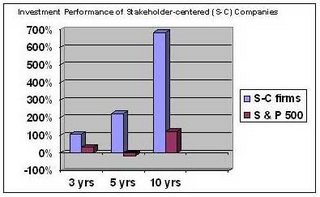
There is a book coming out in February of 2007 called Firms of Endearment: the Pursuit of Purpose and Profit by David Wolfe, Rajendra Sisodia, and Jagdish Sheth. This book takes a look at the difference in performance between stakeholder centered companies- like Whole Foods- and traditional businesses that seek to maximize profits for shareholders (investors). The chart below compares the difference in stock performance between stakeholder companies (SC) and other companies in the S&P 500.

The stakeholder centered companies in the study include: Amazon, Best Buy, CarMax, Caterpillar, Commerce Bank, Costco, eBay, Google, Harley Davidson, Honda, JetBlue, Johnson & Johnson, Progressive Insurance, Southwest Airlines, Starbucks, Timberland, Toyota, UPS, and Whole Foods Market.

This idea reminds me of John Templeton's philosophy. Templeton outperformed the market by an average of 3% annually per year after fees from 1954- 1992. He accomplished this in large part by buying shares of companies that perform a service beneficial to the world. He avoided buying shares in companies that prey on human weakness. One of Templeton's fund managers in the 1990s- Rusty Leonard- has incorporated this investment approach with a distinctly biblical worldview.

2. Executives should be compensated fairly but not outrageously. Whole Foods implements a policy that the highest paid executive makes only 19 times the average paid employee. The average for the S&P 500 was 411 times the average paid employee in 2005. As stewards of stakeholders' interest, executives should become wealthy as long-term stakeholder value is created.

Mackey contends that the best way to deal with envy is to become more transparent with compensation. Whole Foods shares the salaries of all employees. Mackey contends that by having this type of transparency people can see what types of skills are valued and rewarded in the organization and manage their career objectives accordingly.

Along those lines, Whole Foods distributes stock options so that employees can share in the creation of stock value over time. Only 7% of stock options go to the top 16 executives at Whole Foods. In comparison, 75% of stock options go to the top 5 executives at a typical S&P 500 firm.

3. Mackey believes that the stereotypes of good, altruistic non-profit organizations and greedy, selfish corporations are wrong. Mackey contends that the majority of non-profits are inefficient, wasteful and stagnant. He argues that both non-profits and businesses need to migrate towards a holistic model. Business and capitalism can be forces for enormous good in this world. The world has gone from nearly 95% poverty 200 years ago to 60% poverty currently. And with the emergence of China and India, the poverty rate is likely to be less than 25% by 2050. This reduction in poverty is attributed to increased profits, prosperity, technological innovation, etc... But the pursuit of profit at all costs is not a good thing for society and this is why Mackey urges businesses to adopt Conscious Capitalism.

I find Mackey's thoughts line up with my understanding of biblical stewardship even if Mackey doesn't share evangelical, biblical beliefs. A point that I have made in other blog entries is that God gave Adam a stewardship mandate in the Garden of Eden to grow, cultivate, take dominion over the resources that God provides- Genesis 1:28. Many environmentalists long for a return to the Garden like paradise. But God moves creation from a Garden- Genesis to a City- Revelation. Progress is a good thing if it is done according to God-honoring stewardship principles. We should not seek repristination. We should seek biblically progressive reformation. The good that was formed by God has been deformed by sin and needs to be reformed for the purposes of God.

For His Glory,

Ashley Hodge