Tuesday, February 27, 2007

Is Juice Plus Worth the Money?

So many great potential blog topics this week. It was difficult to choose one. First, you have financial "guru" Suze Orman claiming that she has a net worth of around $25 million and that she has $1 million of that invested in the stock market. She says, "I don't care if I lose that." Is this the type of person America wants to be taking financial advice from? Can someone so cavalier about losing $1 million be giving sound financial advice to the average American?

Second, you have some interesting findings coming out of the Tennessee Center for Policy Research about Oscar-winner Al Gore. Al Gore's consumption of electricity and natural gas at his Tennessee mansion according to this report is $1,500/month or 20 times more than the national average. I will likely revisit this on a future blog.

But the blog idea that won out for me this week was whether Juice Plus is a worthwhile supplement. I hesitate to write this because almost everyone I know takes Juice Plus. Hopefully, I don't lose any friends over these opinions of mine. If you haven't heard about Juice Plus, it is a capsule that you can take daily that is supposed to give you many of the same benefits that you receive from eating lots of fruits and vegetables.

I listened to a cd that was put out on the product about a year ago and it seemed convincing. A quick web search turned up some testimonials from medical professionals swearing to the benefits of this product. Friends who used the product regularly claimed that they were avoiding colds and had noticed some health benefits. So, my family started taking the product.

I was a little surprised that it costs so much. A four-month supply of the fruits & vegetable pills and gummies for children (loaded with corn syrup) costs $244. My skepticism was raised due to the expense initially. I started researching the product online. I spoke to a vitamin consultant at a health foods store. The consultant's exact quote to me was, "I have been in the vitamin business for 25 years. First of all, there is no substitute for fruits and vegetables. Period. Second, there are supplements that make similar claims and have similar ingredients to Juice Plus that you can purchase at 1/3 of the price."

That comment made sense to me. That same week my wife- Amy- attended an educational lunch where the guest speaker was a registered dietician. The woman sells Juice Plus and gave a presentation on why proper nutrition is important and how Juice Plus can help. In an email conversation with my wife a comment was made that really got me thinking. The comment was that Juice Plus is legitimate because Ron Blue endorses the product.

Ron Blue is president of the Christian Financial Professionals Network- an organization that I am a member of. Ron Blue has been a well respected voice in the financial planning community from a biblical perspective. A search on Yahoo showed that you can obtain a cd from Juice Plus with a talk given by Ron Blue on the opportunities of a virtual franchise. I think virtual franchise is one of the new code words for network marketing; home-based business opportunity; multi-level marketing; etc...

You can read and study on Juice Plus and whether it is a good product to take. My family is going to a less expensive alternative personally. You can find some interesting research about the product at a wikipedia page on Juice Plus: http://en.wikipedia.org/wiki/Juice_Plus

But a bigger issue to me is should a person of considerable influence in the church be endorsing products that are sold through network marketing? This is not meant to be a criticism of Ron Blue and I intend to ask him this question face-to-face next time I have the chance.

I am a cynic in many ways. I admit it. Sometimes, I wish I wasn't. Life would probably be more enjoyable. One of my thoughts that swirls through my head is that many of these large churches that exist in America are primarily in business to make leaders of the church filthy rich. Either through ministry related activities- Ed Young Jr, TD Jakes, Joyce Meyer, Joel Osteen- come to mind. Or through the peddling of multi-level marketing products. I know some charismatic people who are in positions of leadership in the church who have amassed great wealth through a network marketing opportunity.

But this is not the norm. And here lies the problem. According to R. Hawkins research on network marketing:
  1. 95% of people drop out of network marketing within 6 months.
  2. 99% of people lose money or make absolutely nothing.
  3. The 1% that stay in average around $2,000 a year in profit

You can read about it at http://www.falseprofits.com

With those stats in mind, wouldn't Christians be better off if people of influence endorsed gambling as a better financial strategy than network marketing? Aren't the odds better at the blackjack table?

I don't endorse gambling. It is investing for people who are very bad at math. But the point is: why are so many people sucked into network marketing? And why was I sucked into buying a product that is overpriced and sold through this method? Perhaps we want to believe in the magic solution.

But there are no shortcuts to wealth or health. There are many great people who are involved in network marketing believing something about the product or opportunity that will likely not be found true in the end. Proverbs 13:11, "Wealth obtained by fraud dwindles. But the one who gathers by labor increases it."

For His Glory,

Ashley Hodge

Monday, February 19, 2007

Wanting More

It starts early. We can see the lack of contentment in our children before they turn 3. My son whom I adore- Hudson- loves trains. I enjoy buying him trains because it brings him so much joy.

But even after I purchase him train after train in the Thomas the Train series at ridiculous prices- $10- $20 per train, the lack of contentment becomes evident.

He watches Thomas videos and says, "I don't have Toby, Diesel10, etc..." My wife- Amy- and I constantly remind him to concentrate on what he has instead of what he does not have. He agrees with us. But then two seconds later it is back to, "I don't have..."

My wife asked me this weekend: what is your biggest fear? I thought about it and it isn't a typical answer: death, public speaking, dying young, etc... My biggest fear is living an unfruitful life.

Jesus tied an unfruitful life to being distracted by the love of possessions. Jesus teaches in Mark 4:1-20 about a sower that sows seed on the ground. He says the sown seed is the Word of God/the Gospel- Mark 4:14.

The seed is placed among many different types of soil. One of the types of soil is thorny ground. Jesus explains, "And others are the ones sown among thorns. They are those who hear the word, but the cares of the world and the deceitfulness of riches and the desires for other things enter in and choke the word, and it proves unfruitful."- Mark 4:18-19.

This is our problem in this country. We are receiving the Word of God on thorny ground. The battle for more comfort and more things is one that we will likely take with us to the grave. The lure of things is so subtle. But the danger is that it has the capability to create in our hearts a lack of contenment, gratitude and distraction from things that matter.

I preach this word to myself as I am in the process of upgrading my housing needs. A daughter on the way and the daily desire to office from my home has created a "need" for more space. But sometimes, I wonder if I am just providing justification for my desires.

Sometimes these decisions must be made. But it is important to see the thorns in the whole mess. They are there to choke out our commitment to Christ and this is never a good thing. We must weed our garden daily.

For His Glory,

Ashley Hodge

Monday, February 12, 2007

Littering

We all have our pet peeves in life. One of mine is when I see someone litter. I don't claim to be the most efficient steward of the environment. I am trying to improve.

But there is one thing I cannot tolerate: litter. If you think about it, it is one of the most self-absorbed acts out there. The mindset to litter is: "I am the most important person in this world. If I decide to throw my trash out of my car or while walking around it is because I have the right to do it. Someone else will pick it up. But if they don't pick it up it doesn't matter because this world is all about me."

Littering must stem from one of three motives: unabashed laziness, self-absorbtion or ignorance. To me the sin nature of humans speaks loud and clear when they litter. Does it bother you also? I long for a world where God's justice is revealed (after His mercy is displayed towards us). A world where things are put right.

Litter is a constant reminder of the Fall and why we will be disappointed if we view this world under the curse of sin as paradise. A better day and place is coming for those who trust the promise that Christ will return to rule this world in peace and justice. But in the meantime, as Christians we should strive to make this world a more beautiful place. One small way that we can do that is to never litter and to gently correct those who do.

I have to admit that I have been guilty of correcting those who litter but not with gentleness. My wife- Amy- gets on me for my temper when I see someone throw trash out the window. A couple of recent stories:

One day I pulled up behind a car of teenagers at a red light and watched the driver chuck out a fast food back on the street. To his credit, he did go to the trouble of putting all of his trash in the bag instead of scattering it piece by piece. I quickly put my car in park, got out of the car, grabbed the bag and knocked on their window. They rolled it down and I said sarcastically, "You accidentally dropped this." The driver was embarrassed and said, "Thank you" and took the trash back into the car. It felt good. But that outcome could have been less than favorable with the wrong person.

Another incident was a young woman throwing out a host of trash in the neighborhood I live. I decided to follow her for a few blocks laying on the horn the whole way. It is not pretty. I lose all sense of maturity when I see things like this. Hopefully, one of these stories isn't the prelude to my funeral.

Jeremiah 2:7 tells us, "I brought you into a fertile land to eat its fruit and produce. But you came and defiled my land and made my inheritance detestable."

We should always be asking ourselves tough questions with how much we need to consume. And for God's sake: don't litter!

For the Glory of His Creation,

Ashley Hodge

Monday, February 05, 2007

Why I believe Calvinism is true


I am reading through a chapter on God's Providence in Systematic Theology by Wayne Grudem. It has been a reminder to me that what we believe about the sovereignty (control) of God over all things is an important issue to how we view stewardship and life.

I did not come by Calvinism naturally. I was first introduced to the ideas by my father-in-law eight years ago. I became interested in learning about the differences in philosophies between Arminianism and Calvinism. Those who agree with John Calvin's (1509-1564) interpretation of Scripture on the issue of God's sovereignty and human free will are often referred to as Calvinists. Those who agree with Jacobus Arminius (1560-1609) on these issues are called Arminians.

A quick summary of the beliefs of each of these camps:

Calvinism's main points can be remembered by the acronym: TULIP

1. Total depravity: Because of the fall of man, every person is born into the world enslaved by sin. Because we are by nature inclined to serve our own selfish interests, we will not choose God.

2. Unconditional election: God's choice from eternity of those He will bring to Himself is not based on merit or virtue. It is unconditionally centered on God's mercy.

3. Limited atonement: The death of Christ takes away the penalty of sins of those on whom God has chosen to have mercy.

4. Irresistible grace: The saving grace of God is effectually applied to those He has determined to save. His grace can overcome the most stubborn, callous heart.

5. Perseverance of the saints: Any person who has been truly converted to Christ will persevere in the faith. The word saint is used in the sense that people are set apart by God to pursue obedience to Him.

Arminianism's five beliefs are:

1. Free will: The fall of man was not total. Every person has enough good in them to accept Christ as Savior.

2. Conditional election: God's foreknowledge of who would believe and man's act of faith are the conditions that lead to salvation. God foreknew those who would freely choose Him.

3. Universal atonement: Christ died for everyone. God never wills that anyone should die apart from Christ, but each person must exercise their free will in trusting this atonement in order to be saved.

4. Obstructable grace: The Holy Spirit woos people to Christ. God's will to save all men can be frustrated by the will of man. Every person must exercise their own will first and then they can be born again.

5. Falling from grace: People can lose their salvation by choosing to fall away from Christ. Mankind must continually believe in order to be saved.

A few comments are in order. First, I consider this debate to be of secondary importance. There is great mystery in how the sovereignty of God and human free will co-exist. I affirm the idea that God is sovereign and humans are responsible. I believe that most people in both camps would agree with that statement.

I have close friendships with Christians who fall into the Arminian category and I have close friendships who are devout Calvinists. I would never hope to jeopardize those relationships over an issue that at the end of the day, we have to humbly admit that there is mystery and lack of clarity.

I came to the conclusion that Calvinism is the better understanding of God's sovereignty/human free will because of three major factors.

1. The weight of Scripture. Both sides of this debate can point to troubling verses for the other side to explain. But after studying the whole Bible on this issue, I conclude that Calvinism is the easier position to defend. There are too many verses that defend the total and complete sovereignty of God over everything in His creation- including human free will- for me to believe in Arminianism.

2. The weight of church history. The proponents of Calvinism have a larger list of theological heavyweights: Augustine, Luther, Calvin, Jonathan Edwards, JC Ryle, BB Warfield, Spurgeon, George Muller, John Owen to name a few. If you read about these men's lives, you can't help coming away with an awe of their study habits. The fact that they came to Calvinist conclusions was persuasive to me. We always stand on the shoulders of giants when we clarify these issues.

3. The belief that faith in a God who is completely in control over all things is much easier to live with than a God whose purposes can be thwarted by the free choices of humankind. There are some tough issues to work through around why evil exists in defending Calvinism. But I am comfortable with understanding that in the new heavens and earth. God has given us the answer to evil in Christ. But the issues surrounding Arminianism- like the potential for us to fall from grace in heaven; God's inability to control the future; etc... are way too hard for me to accept.

I believe that a complete trust in the sovereignty of God is the basis for stewardship. It is because I believe that God is methodically and wisely unfolding a plan for all of creation to be restored under the rule of Christ that I desire to be the best steward of this life.

For His Glory,

Ashley Hodge

Monday, January 29, 2007

Cycles of Investing

The Good Book tells us, "There is a season and a time for every matter under heaven"-Ecclesiastes 3:1.

Likewise, in the world of investing every type of asset has its day in the sun and every type of asset has its winter.

You will often do well as an investor if you buy the asset that has been beat up in price the last 5-10 years and you are cautious about adding to assets that have appreciated significantly during that time span.

With that in mind, I did some research on the returns of different types of assets from 1999-2006. My compliance disclaimer is that these figures are for illustrative purposes only and are not to be construed as specific investment advice for individuals. Always check with your financial advisor as to what is appropriate for your situation.

Here are the 8-year average annual returns for the following assets. I chose this eight year time period because some of these asset types only date back to 1999.

  • Small-Cap Stock Index (Russell 1725): 8.02%
  • Large Growth Stock Index (Russell 1000 Growth): -0.75%
  • Large Value Stock Index (Russell 1000 Value): 7.76%
  • International Stock Index (EAFE): 6.70%
  • Real Estate Index (REIT Index): 18.65%
  • Multi-Strategy Hedge Fund Index (Barclay): 11.90%
  • Bond Index (Lehman Brothers): 5.44%
  • Commodity Index (Goldman Sachs): 14.10%

I like the odds that large company growth stocks will do better than real estate over the next 8 years. But sadly, many investors will see the recent returns of real estate and will load up their 401ks and investment accounts with real estate funds.

One of my fundamental beliefs is that in life you will do much better if you go against the crowd, but it is sometimes a lonely place. Soren Kierkegaard, "The majority of people are not so afraid of holding a wrong opinion, as they are of holding an opinion alone."

For The Goal of Wise Stewardship,

Ashley Hodge

Monday, January 22, 2007

Give, Save or Pay Off Debt?

You have an extra $10,000. What is the most spiritual decision?

A. Give the money to a charitable organization
B. Save/Invest the money for future needs
C. Pay down debt
D. Any of the above

I believe the answer is D. We should commit the matter to prayer. But you can find Scriptural support for any of these three options.

The Christian is told to give generously with a cheerful heart: "The point is this: whoever sows sparingly will also reap sparingly, and whoever sows bountifully will also reap bountifully. Each one must give as he has made up in his mind, not reluctantly or under compulsion, for God loves a cheerful giver," 2 Corinthians 9:6-7.

I have seen truly generous people continue to attract resources. This allows them to be even more generous. It is a spiritual law that God has set in His universe. It doesn't make sense to the rational mind. A false generosity that only gives to get may experience the rewards of "you scratch my back and I will scratch yours." But the true blessings are never fully enjoyed unless generosity comes from a heart that has been changed by Christ.

The Christian has biblical examples of why it is important to save. I read one example this morning. God instructed Joseph to tell Pharaoh to save seven years worth of grain for a famine was coming on the earth. Joseph tells his brothers, "And do not be distressed or angry with yourselves that you sold me here, for God sent me before you to preserve life. For the famine has been in the land these two years, and there are yet five years in which there will be neither plowing or harvest. And God sent me before you to preserve for you a remnant on earth, and to keep alive for you many survivors." Genesis 45:5-7.

I believe there are times when God puts the desire in our hearts to save. The reasons may not seem clear at the time. But then the economy turns down and you lose a job. A friend or family member has a crisis. A giving opportunity comes that you didn't expect. How could you help in a tangible, financial way unless you had savings?

Finally, I believe the Scriptures are clear that paying down debt is a worthwhile goal. Debt is a way of life for most American families. I carry debt on my home- although I am striving to pay it off quickly. Debt on a potentially appreciable asset can be argued for- home, business, education. But debt on depreciable assets- clothes, furniture, cars- doesn't make good financial sense. We are told by Paul, "Owe no one anything, except to love one another..." Romans 13:8.

The point is that we should not be manipulated to think that any one of the above uses of money- give, save, pay off debt- is better than another. The biblical Christian should work towards all three objectives and pray for the Spirit's leading. A commitment to strategic living that properly balances spending, giving, saving and paying off debts helps us to be in a position where God can use us for His purposes.

"A wise man saves for the future, but a foolish man spends whatever he gets," Proverbs 21:20.

For His Glory,

Ashley Hodge

Monday, January 15, 2007

Reading Good Books


This is a photo of my home office/study. I love books. I am reading through a couple of great books currently- Simply Christian by N.T. Wright and Systematic Theology by Wayne Grudem. I have been thinking of the books that have influenced me to place my trust in Christ.

Mark Twain remarked, "The person who doesn't read good books is no better off than the person who cannot read." Here are 5 books that have influenced my faith and also some short comments on why they have impacted me. I hope you read them.

1. Bible. Too many Christians never read the Bible. It is hard to understand why this is the case. Christians are to be people of the Word and to use this book as our life's guide. I encourage everyone- Christian and non-Christian- to read the Bible and study its contents. There are some great websites out there to help you read through the Bible in a year. One is the http://www.oneyearbibleblog.com/

2. Holiness- JC Ryle. This was the right book for me at the right time. I was at a point in my life where I had committed to Christ intellectually but had not experienced true conversion. This book helped me understand what true conversion to Christ is. I am forever grateful for having found JC Ryle's writings. He is one of the people I am most excited about meeting in Heaven.

3. The Chronicles of Narnia series- CS Lewis. Before reading these books, my view of Heaven was boring. After reading this series, I have been fired up about Heaven. It will be a prepared place for a prepared people. Lewis' biblically inspired vision is that Heaven is a place of adventure, learning, renovation of beautiful creation where the curse of sin is removed. Heaven will be a place where the Trinitarian God is tangibly present and sin is absent.

4. Provocations- Soren Kierkegaard. This book is a great summary of Kierkegaard's thoughts. I find many of Kierkegaard's thoughts to be relevant to our current society in the West. He wrote about the corruption of the church and what true Christianity should look like in contrast to this corruption. Kierkegaard was one of the giants of philosophy and was filled with a God-centered passion.

5. Creation Regained- Al Wolters. I had to read this book for an Apologetics class at Westminster Theological Seminary in Dallas. The book does a great job of explaining the major themes of the Bible: Creation, Fall, Redemption. It also transformed the way I think about the secular versus sacred distinctions. Wolters teaches that all of creation is good and needs to be reformed in ways that are glorifying to Christ. What was formed by God has been deformed by sin and needs to be reformed for the purposes of Christ.

I pray that some good books find you in 2007. And since it is a day where Martin Luther King, Jr's life is remembered, I thought of an excellent biography that I read about him several years ago: Let the Trumpet Sound- Stephen Oates.

For God's Glory,

Ashley Hodge

Monday, January 08, 2007

Conscious Capitalism

I read an excellent essay on Conscious Capitalism by John Mackey- founder of Whole Foods. If you are interested in how the pursuit of profit and stewardship of people, money and the environment can co-exist, you will find the ideas that Mackey sets forth as worthy of consideration. The essay can be found here:

http://www.wholefoods.com/blogs/jm

I will attempt to summarize some of Mackey's important points:

1. Profits are like happiness. They are best achieved when you don't focus on them. Mackey argues that profits will come when the stakeholders in the business- employees, management, vendors, customers and investors- are consistently satisfied.

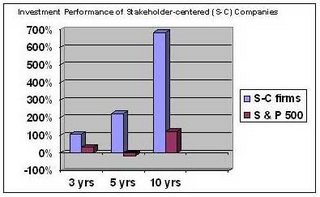
There is a book coming out in February of 2007 called Firms of Endearment: the Pursuit of Purpose and Profit by David Wolfe, Rajendra Sisodia, and Jagdish Sheth. This book takes a look at the difference in performance between stakeholder centered companies- like Whole Foods- and traditional businesses that seek to maximize profits for shareholders (investors). The chart below compares the difference in stock performance between stakeholder companies (SC) and other companies in the S&P 500.

The stakeholder centered companies in the study include: Amazon, Best Buy, CarMax, Caterpillar, Commerce Bank, Costco, eBay, Google, Harley Davidson, Honda, JetBlue, Johnson & Johnson, Progressive Insurance, Southwest Airlines, Starbucks, Timberland, Toyota, UPS, and Whole Foods Market.

This idea reminds me of John Templeton's philosophy. Templeton outperformed the market by an average of 3% annually per year after fees from 1954- 1992. He accomplished this in large part by buying shares of companies that perform a service beneficial to the world. He avoided buying shares in companies that prey on human weakness. One of Templeton's fund managers in the 1990s- Rusty Leonard- has incorporated this investment approach with a distinctly biblical worldview.

2. Executives should be compensated fairly but not outrageously. Whole Foods implements a policy that the highest paid executive makes only 19 times the average paid employee. The average for the S&P 500 was 411 times the average paid employee in 2005. As stewards of stakeholders' interest, executives should become wealthy as long-term stakeholder value is created.

Mackey contends that the best way to deal with envy is to become more transparent with compensation. Whole Foods shares the salaries of all employees. Mackey contends that by having this type of transparency people can see what types of skills are valued and rewarded in the organization and manage their career objectives accordingly.

Along those lines, Whole Foods distributes stock options so that employees can share in the creation of stock value over time. Only 7% of stock options go to the top 16 executives at Whole Foods. In comparison, 75% of stock options go to the top 5 executives at a typical S&P 500 firm.

3. Mackey believes that the stereotypes of good, altruistic non-profit organizations and greedy, selfish corporations are wrong. Mackey contends that the majority of non-profits are inefficient, wasteful and stagnant. He argues that both non-profits and businesses need to migrate towards a holistic model. Business and capitalism can be forces for enormous good in this world. The world has gone from nearly 95% poverty 200 years ago to 60% poverty currently. And with the emergence of China and India, the poverty rate is likely to be less than 25% by 2050. This reduction in poverty is attributed to increased profits, prosperity, technological innovation, etc... But the pursuit of profit at all costs is not a good thing for society and this is why Mackey urges businesses to adopt Conscious Capitalism.

I find Mackey's thoughts line up with my understanding of biblical stewardship even if Mackey doesn't share evangelical, biblical beliefs. A point that I have made in other blog entries is that God gave Adam a stewardship mandate in the Garden of Eden to grow, cultivate, take dominion over the resources that God provides- Genesis 1:28. Many environmentalists long for a return to the Garden like paradise. But God moves creation from a Garden- Genesis to a City- Revelation. Progress is a good thing if it is done according to God-honoring stewardship principles. We should not seek repristination. We should seek biblically progressive reformation. The good that was formed by God has been deformed by sin and needs to be reformed for the purposes of God.

For His Glory,

Ashley Hodge

Friday, December 29, 2006

New Year

The end of the year is a time of reflection for me. I enjoy reviewing the goals that I set in 2006 and crafting new goals for 2007. This process is a reminder of how short I fall from God's standard of holiness. But it is also a testimony of God's grace that I was able to make progress in some areas.

I am going to share with you the goals I set for 2006 in the areas of whole-life stewardship and how I measured up to these standards. I am also including some 2007 goals. By being transparent in these areas, my desire is that two things would be accomplished:

  1. It motivates me further to excel at areas of whole-life stewardship. Knowing that I have made some of these objectives public to the few people that read this blog adds an extra layer of accountability to keep me focused. Paul instructs us in 2 Corinthians 13:11 to aim for perfection.
  2. I hope that this will encourage you to set goals for stewardship in 2007. I am a huge believer in the idea that: what you measure will improve. Proverbs 16:9, "In his heart a man plans his course, but the Lord determines his steps."

I believe that we should pray for God to lay some areas on our heart that are consistent with His will for our lives and will bring Him glory. This is at the root of what Jesus teaches in the Sermon on the Mount in Matthew 7:7-11. God desires to grow us in faithfulness and usefulness. He delights in all those who fear Him and put their trust in His unfailing love- Psalms 147:11.

My 2006 Stewardship Goals and the results in red:

Money

  1. Strive to live on less than $7000/month for housing, auto and living expenses. Our family fell short of this goal by around $700/month. This included all expenses except for taxes, health insurance, savings and giving.
  2. Give over $20,000 to the work of Christ in 2006. We accomplished this goal through God's provision.
  3. Save at least $20,000 in 2006. We exceeded this goal.
  4. Contribute an additional $1000/month towards paying off home. I started strong here, but quit making extra payments in the summer of 2006. Part of my rationale for not continuing was due to an upcoming move to another home. Cash needed to be more liquid.

Abilities

  1. Read 12 financial/investment books in 2006. Attend continuing education classes to hone skills and bring practical wisdom to clients. I read 9 financial/investment books in 2006. I did attend two conferences- LPL and CFPN.
  2. Pray regularly for clients-souls, health, finances, personal growth, families. I did consistently pray for clients. I pray for 5-6 clients each day so every month I am praying through my client list.
  3. Execute vision of Stewardship Mandate- edit book, update website regularly, quarterly newsletters and client events. I did not finish editing the book. But I hope to have a new and improved edition out in 2007. I did update the website regularly and send out quarterly newsletters. The quarterly client events never happened.
  4. Quarterly reviews of client assets and a proactive approach to adding value to their lives. I did review every client account quarterly and suggested appropriate changes. I hope to improve on the proactive approach to adding value in 2007.

Time

  1. Three hours per day of focused spiritual growth- Bible study, prayer, ministry to others and reading spiritual growth books. Time spent in these areas was closer to 2 hours per day in 2006.
  2. Less than one hour per day of television. We accomplished this goal.
  3. Invest at least one hour per day playing with, reading to and teaching my son- Hudson. This goal was accomplished.
  4. Average 40 hours per week of concentrated work- financial planning and client service. I averaged 37 hours per week of focused work in 2006. This does not include some areas that others might categorize as work- travel time; socializing with clients.

Health

  1. Exercise for at least four hours per week. Goal of having a 33 inch waist with less than 10% body fat. I exercised on average 6 hours per week in 2006. My waist starting the year at 36 inches and ended the year at 34 inches. I never measured my body fat. Although my guess is that it is below 15% but not below 10%.
  2. Drink an average of 100 ounces of water per day. Limit cola intake to less than 20 ounces per day. I averaged 105 ounces of water daily. My cola intake in 2006 was over 30 ounces per day. Although this has dropped to less than 20 ounces per day in the last six weeks due to my decision to eliminate all diet drinks.
  3. Partial fast once per week- less than 1000 calories per day on Wednesdays with no cola intake. I completely bombed on this goal. I think this lasted about 2 weeks.
  4. Average at least six hours of sleep per night. I averaged 7 hours per night of sleep.

Goals for 2007

Money

  1. Live on less than $8000/monthly for housing, auto and living expenses.
  2. Give over $25,000 for Christian work; Save over $25,000.

Abilities

  1. Pray for clients daily. Pray for every client at least once per month.
  2. Upgrade stewardship resources; offer free version of book through pdf file and create audio version that will be available at cost. Read 12 investment/financial books.

Time

  1. No technology from 6pm- 5am. Use this time for family; devotions; relationship building; reading; projects and sleep.
  2. Average 3 hours per day of spiritual growth; 40 hours per week of focused work; two hours per day playing with, instructing and loving on our kids.

Health

  1. Average less than 300 calories per day of cola and processed foods. Discipline in eating foods that are healthy.
  2. Exercise at least 4 hours per week; sleep at least 6 hours per day.

I also want to have some fasting discipline built in, but I need to pray about something I can actually accomplish on that end.

God is good. My New Year's wish is that we would all celebrate His goodness in 2007 by striving to become the most effective steward of the resources that He entrusts to us.

I would love to hear from you. If you have some stewardship goals to share for 2007, please let me know. I would welcome the opportunity to pray for you and ask that you pray for me.

For His Glory,

Ashley Hodge

Saturday, December 23, 2006

Christmas reflections

Christmas for me is a time of reflection. I think about the year and how God has been gracious to us in too many ways. I have the challenge of telling the Christmas story to a 2-year old son in a way that he understands.

Two significant Bible passages centered on Christmas that are particularly meaningful to me are:

Written around 700 years before the birth of Christ, Micah prophesies,

2 "But you, O Bethlehem, though you are small among the clans of Judah, out of you will come for me One who will be ruler over Israel, whose origins are from of old, from ancient times.

3 Therefore, Israel will be abandoned until the time when she who is in labor gives birth and the rest of his brothers return to join the Israelites.

4 He will stand and shepherd His flock in the strength of the Lord, in the majesty of the name of the Lord His God. And they will live securely, for then His greatness will reach to the ends of the earth.

5 And He will be their peace"- Micah 5:2-5.

Micah tells us that the Savior will be born in Bethlehem- a small obscure town. He also lets us know that His origins were before creation which is explained more fully in the 1st chapter of the Gospel of John. We are told that the Jews would fall away from God for the next 700 years, but God has something in store to bring them back to Him- a Savior. And finally in verses 4-5, we are promised the hope of peace and security when Christ returns to rule a resurrected earth.

From the promise of Christ in the Old Testament, He is revealed in the pages of the New Testament. Luke tells us,

8 "There were shepherds living out in the fields nearby keeping watch over their flocks at night.

9 An angel of the Lord appeared to them, and the glory of the Lord shone around them, and they were terrified.

10 But the angel said to them, 'Do not be afraid. I bring you good news of great joy that will be for all people.

11 Today in the town of Bethlehem a Savior has been born to you; he is Christ the Lord.

12 This will be a sign to you: You will find a baby wrapped in cloths and lying in a manger.'

13 Suddenly a great company of the heavenly host appeared with the angel, praising God and saying,

14 'Glory to God in the highest, and on earth peace to men on whom His favor rests.'"- Luke 2:8-14.

A humble Savior born in a humble town to humble parents. Good news is proclaimed to all people- rich, poor, man, woman, every skin color and nationality. We have been given a way to know God through Christ.

I conclude with the lyrics to my favorite Christmas song- God Rest Ye Merry Gentlemen- performed by the Bare Naked Ladies and Sarah McLachlan. If you haven't heard the song, you have to get a copy. I always wonder if the artists performing these great Christmas songs have any idea what the lyrics mean.

God rest ye merry, gentlemen,
Let nothing you dismay,
Remember Christ our Saviour
Was born upon this day;
To save us all from Satan's power
When we were gone astray.

[1st Chorus]O tidings of comfort and joy,
Comfort and joy,
O tidings of comfort and joy!

From God our heavenly Father
This blessed angel came;
And unto certain shepherds
Brought tidings of the same;
How that in Bethlehem was born
The Son of God by name.

[1st Chorus]

[2nd Chorus] O, star of wonder, star of night,
Star with royal beauty bright,
Westward leading, still proceeding,
Guide us to that perfect light.

Born a king on Bethlehem's plain;
Gold I bring to crown Him again;
King forever, ceasing never,
Over us all to reign.

[2nd Chorus]

Glorious now behold Him arise,
King and God and sacrifice,
Hallelujah! Hallelujah!
Worship Him, God Most High.

[2nd Chorus]

God Rest Ye Merry Gentlemen
Let Nothing You Dismay
O Holy Child

Merry Christmas,

Ashley Hodge

Saturday, December 16, 2006

Diet Coke Addiction

One of my stewardship struggles in 2006 and for many years prior has been weaning myself off large quantities of diet coke.

I have read quite a bit of research on diet coke and the effects of aspartame on health. I had in the past dismissed a lot of the alarmist material linking aspartame to brain tumors, neurological disease and other health ailments because there wasn't scientific research to support it.

I had sided with Dr. Walter Willett- chairman of the Department of Nutrition at Harvard. Willett writes in Eat, Drink And Be Healthy that
diet colas are not the health hazard that alarmists claim. They are just an expensive way to obtain water.

Many friends have attempted to persuade me to think differently in the past. The tipping point came late this year. I spent three days of vacation with a client who is a doctor in his 70s. He persuaded me that from his research on aspartame that at best it is not healthy. At worst, some people experience many negative health effects as a result of over-consumption of diet colas. He was alarmed to hear that I was averaging over 34 ounces of diet coke per day. His exact quote to me, "Ashley, you don't see deer panting for diet colas. It is not good. Get off it."

Next, I had conversations with William Reymond- a french investigative journalist- who wrote a book on Coca-Cola and has an upcoming book called Toxic that describes some of the ways that chemicals in food are causing health problems and obesity. William and I have become friends through a basketball game. He had been a loyal diet coke drinker for many years, but his research led him to conclude that aspartame is not safe.

I made the decision to quit cold turkey in November of this year. It was a rough couple of days. I was addicted to this stuff. My conclusions are unscientific. But I must admit, after the first few days of withdrawal I have noticed some good health benefits from quitting.

One, my thinking is clearer. Any diet coke drinker knows that if they consume too much in a day, there is a fog that hangs over the brain. This has been eliminated. My thinking is now foggy for completely different reasons; not a diet coke addiction.

Second, I used to grind my teeth at night excessively. One of the benefits from no longer drinking diet coke is that I am not grinding my teeth as much. My sleep at night has been more restful.

Is diet coke harmful? I don't know. It is probably not going to affect most people if they drink it in moderation- less than 12 ounces per day. But if you are anything like me, that moderation is difficult to achieve. There is something addictive about the artificial sweeteners that creates a craving for more.

It is better to get off the stuff and drink water. Tea, coffee or sodas/fruit juices that you would find at a health food store are much better alternatives if you are craving something other than water.

Excelling at the stewardship of health should be the goal of every thoughtful person. But especially the Christian who has been taught that the body is sacred to God. It is the house of His Spirit- 1 Corinthians 6:19-20. We all have our contradictions to God's ideal standard. For many years, the over consumption of diet coke has been one of my contradictions. But by His grace, I have been able to quit and no longer desire to be enslaved by it again.

I pray that 2007 will be a great year for you in making progress in areas of whole-life stewardship. Christ didn't come just to save souls. He came to save whole persons.

For The Goal of Resurrected Health,

Ashley Hodge

Saturday, December 09, 2006

Distractions

One of the impediments to a life of stewardship is continual distractions. We live in a distracted age. It is difficult to have conversations that go beyond the superficial because most people never think about the important questions in life. They are too busy being distracted to discover purpose or meaning in life. The spirit of the age is summed up in the lyrics of Edie Brickell's song What I Am:

I'm not aware of too many things
I know what I know if you know what I mean
Philosophy, is the talk on a cereal box
Religion, is a smile on a dog
I'm not aware of too many things
I know what I know if you know what I mean
Choke me in the shallow water before I get too deep
What I am is what I am are you what you are or what?

We are too busy during the holidays to think and meditate on Christ and how devotion to Him should be our focus. We have too many holiday parties to attend. Too many presents to buy. Too much television to watch. The urgent chokes the eternal.

This is not a new problem. Blaise Pascal- the brilliant mathematician and philosopher- wrote about this in Pensees. Fragment 133 he writes, "Being unable to cure death, wretchedness and ignorance, men have decided, in order to be happy, not to think about such things." Pascal describes some of the ways that people choose diversions rather than contemplating the big questions in life.

Pascal writes on how people are too busy hunting, gambling, going to war and amusing themselves. We shun anything of significance. Gambling is still distracting people daily. But Pascal would have had a stronger case to write about in 2006 than he did in 1660. He did not foresee the greatest of all distractions: entertainment on demand. We live in an age where we can avoid ever having a serious thought.

Paul wrote in 2 Corinthians 11:3, "But I am afraid that as the serpent deceived Eve by his cunning, your thoughts will be led astray from a sincere and pure devotion to Christ." As we enter a time of reflection at the end of the year, my prayer is that we will reflect on the big questions and seek to limit distractions to those questions:
  1. Why am I here?
  2. What happens to me after I die?
  3. Is there something true to live and die for?
  4. How can I glorify God the most?
  5. How can I be the maximum amount of good to the maximum amount of people?

Jonathan Edwards wrote in his 70 Resolutions: "Resolution 9- Resolved, to think much on all occasions of my own dying, and of the common circumstances which attend death." Thinking about death is the gateway to living. The big questions are calling? Will we answer?

For His Glory,

Ashley Hodge

Friday, December 01, 2006

The Case for Telecommuting

I was reviewing our family's monthly budget this morning and comparing it to budgets in past years. One thing that stuck out to me is that despite the increase in gas prices, I was spending less per month on gas than I did four years ago.

I came to another conclusion in reviewing the budget. I have been able to earn more income and charge clients less in the process. I am able to spend more time with my wife and 2-year old son. When the weather is bad or I have a sickness that would prevent me from going to the office, I can still have an effective work day. My dry cleaning bill is considerably less per month. How am I able to do this? I am one of the 2% of US workers that telecommute full-time.

The federal government understands what is at stake here. Surprisingly, they are ahead of the curve on encouraging employees to work from home. They have set up a website to promote the benefits of telework: http://telework.gov

Reuters released an estimate that 25% of the US workforce could telecommute- perform their jobs from home. If 25% of the workforce would work from home just two days per week, the savings in gasoline per year would be over $4 billion. Imagine how much better traffic would be in your city if you eliminated 1 out of every 4 cars from the road each day?

I believe there is a stewardship issue at heart here. We need to ask the question: how can I consume less? There may not be easy apparent answers. But if you keep asking the question, God will reveal some solutions over time. The steward's motto should always be: how can I become more frugal towards myself and more generous to others?

I routinely talk to friends who tell me that they spend over 2 hours per day in the car commuting. That is a lot of time per day that can be spent on more productive areas. There are many studies that indicate telecommuters are more effective in their work and are able to achieve greater life/work balance.

Are you able to telecommute? If you are self-employed, you should give it serious consideration. Do your clients really care if you have an office?

If you are working for an employer, there is a helpful article on how to propose the idea:
http://www.quintcareers.com/telecommuting_options.html

I am reminded of the truth of Ecclesiastes 7:29, "God has made man upright (simple), but they have sought out many schemes (complexities)." We often make life more complicated than it has to be.

For His Glory,

Ashley Hodge

Friday, November 24, 2006

Unity

I am reflecting on the topic of unity in the body of Christ during this Thanksgiving holiday. I have been reading through Wayne Grudem's excellent book Systematic Theology. It is a large book- over 1000 pages. But it takes the important topics in the Christian faith and explains them in a concise, easy to read format.

I would encourage anyone who wants to understand what the Bible teaches to study this book. I have been studying it with a friend. You could complete the book in a year if you read 100 pages per month and then meet with the friend to discuss what you have read.

I have good friends who are devoted to Christ among many races and denominations within Christianity. One of the most effective tools that our Enemy uses is to deceive our minds and hearts into concentrating on the areas that divide rather than unite us. I am becoming more ecumenical (promoting Christian unity throughout the world) in my belief system as I age.

Unity starts with the Trinity. There has been perfect unity among the three Persons of God for eternity. God is unified as Father, Son and Holy Spirit. The Christian affirms the following about the Trinity- represented visually by the diagram of the Trinitarian Shield above:

1. God is three persons.
2. Each person is fully God.
3. There is one God.

Ephesians 4:1-6 instructs us:

"I therefore- a prisoner for the Lord- urge you to walk in a manner worthy of the calling to which you have been called, with all humility and gentleness with patience, bearing with one another in love, eager to maintain the unity of the Spirit in the bond of peace. There is one body and one Spirit- just as you were called to one hope that belongs to your call- one Lord; one faith; one baptism; one God and Father of all- who is over all, through all and in all."

I need to ask myself every time I seek to exercise pride over another believer in regards to a spiritual disagreement: am I seeking unity? Am I acting in humility, gentleness and patience? One of the beautiful things about the Church is that it brings together people who have nothing in common outside of Christ. It can be a powerful witness to the world that God is at work because it makes no sense for those who have nothing else in common to be acting in love towards each other as brothers and sisters.

When I speak of unity, I am not referring to accepting all beliefs as being equal in importance. Although I respect the Muslim, Jew, Buddhist, Hindu and atheist, I reject their conclusions. I have them as clients, friends and neighbors. But my goal is to persuade them through words and actions that biblical Christianity is true.

I cannot be unified with a liberal Christian who rejects the Bible as authoritative. Nor can I be unified with those who reject the Trinity (as defined above)- like Jehovah Witnesses and Mormons. It is also difficult to be unified with anyone who accepts orthodox Christian beliefs but then lives as none of them were true. I will leave it to a just and fair God as to the state of their souls.

But any Christian who accepts the major beliefs of evangelicalism, I seek unity. That which unites us is much greater than what divides us. JC Ryle gave 5 distinctives of evangelicals in Knots Untied:

1. Belief in the absolute supremacy of Holy Scripture- 66 books from Genesis to Revelation- that make up the Protestant Bible. The Old Testament Apocrypha used in the Catholic or Orthodox traditions is useful but not inspired according to evangelical creeds.

2. Belief in the depth and prominence of human sinfulness and corruption- all of creation is fallen and in need of redemption.

3. Paramount importance to the work and office of Jesus Christ- redemption for all of fallen creation is found only in the work of Christ.

4. High place which it assigns to the inward work of the Holy Spirit in the hearts of people- no one comes to God unless the Holy Spirit calls, convicts and changes them.

5. Belief that the Holy Spirit's work to change a person inwardly will be displayed outwardly through good works and an increasing commitment to holiness- those who belong to God strive for holiness without which no one will see the Lord- Hebrews 12:14.

At the heart of stewardship is unity. God has called Christians to walk with Him in faith. He has commanded us to love Him with all of our heart, mind, strength and soul. And to love our neighbor as ourselves. He has instructed us to use money, ability, time and health to glorify Him. Christians should seek to be as broad as the Bible. We should learn and grow in our understanding of Scripture. This will cause disagreements. But disagreements on secondary issues should never divide us.

We have an opportunity to show the world that Christ is real and His power to redeem and change is total. Unity is a beautiful thing. We need to get back to our roots where Christ is everything and love for others motivates everything we do.

I remember reading about a dream of John Wesley- founder of the Methodist church. Wesley was in Heaven and asking an angel what Christians were present. Wesley asked in succession: Are there Catholics here? Presbyterians? Baptists? Episcopalians? Greek Orthodox? Pentecostals? The angel replied, "No." Wesley confused said, "Only Methodists?" The angel replied, "No, only Christians."

For the Unity of God- Father, Son and Holy Spirit,

Ashley Hodge

Thursday, November 16, 2006

Stewardship Plan- Health

Most people know what choices they should be making to live a healthier life. But few people have the discipline to consistently live in a healthy way- myself included.

The Bible is clear that not only our souls are sacred to God but our bodies as well. Paul tells us in 1 Corinthians 6:19-20, "Do you not know that your body is a temple of the Holy Spirit within you, whom you have from God? You are not your own, for you were bought with a price. So glorify God in your body."

The context of these verses have to do with Paul's warnings against sexual immorality. But the principle that our bodies are sacred to God and how we treat them applies to every aspect of our health.

I speak from experience when I say that making changes in your health habits will radically change your life for the better. At age 24, I weighed 250 lbs on a 6'3" frame with 20% body fat. My cholesterol level was over 200. My blood pressure and pulse rates were high. I changed my eating and exercise habits. I started measuring everything and setting goals. I now am 37 and weigh 195 lbs with 12% body fat. My cholesterol, blood pressure and pulse rates are in the excellent range. I say this not from a source of pride, but to encourage you that changes can be made no matter where your starting point is. In my study and experimentation of what constitutes good health, I have discovered four keys:

1. Reduce Stress.

Stress is an often neglected part of the health picture. People can exercise, eat well, get proper rest and still be on unhealthy if they do not manage stress well. Exercise, diet and sleep are all integral parts of reducing stress. But there are other areas that are important for us to focus on- four areas come to mind:

Meditation- prayer and reflection on the Bible should be the starting point of every believer's day. David tells us that everyone who is godly should offer prayers to God at a time when He may be found. He is our hiding place to preserve us from trouble- Psalm 32:6-7.

Plan- Thoreau said, "Most people live lives of quiet desperation, but I have chosen to live deliberately." Many good things happen to us despite our plans. But planning is a God-given skill that helps us reduce stress. The disorganized life leads to stress. We should constantly ask ourselves: what do I need to purge from my possessions and schedule to make my life simpler and less stressful?

Forgiveness- How many people do you know that add constant stress to their lives by harboring bitterness and a lack of forgiveness? A lack of forgiveness is stressful. Grace is the peaceful, pleasant way. Jesus says, "If you forgive others their sins, your heavenly Father will forgive you. But if you do not forgive others, neither will your Father forgive you."- Matthew 6:14-15. We must daily forgive. We are much worse than we could ever imagine and God is far more graceful than we would ever give Him credit for. The truth of this must compel us towards forgiveness.

Quiet- Life is too noisy and stressful. We should make intentional efforts to reduce the noise. Kierkegaard and others have labeled noise- the tyranny of the urgent. The piece of mail/email we have to read to be better informed; the compelling news story; the important sporting event on television. All of these areas ask for our time and focus, but do they add value to our lives? My family is attempting to turn off all technology from 6pm- 5am. This is a work in progress. I have been recording sporting events that I want to watch. And a funny thing happens... after I check the score in the morning, I don't want to watch most of the games I record. We need to cultivate quiet in our lives.

2. Rest

About 25% of the US population have reported problems with insomnia. Eclessiastes 5:12, "Sweet is the sleep of a laborer, whether he eats little or much, but the full stomach of the rich will not let him sleep." Solomon was telling us something profound here. We should hold on loosely to all of life's cares and travel light. More stuff equals more worry. If you are having trouble sleeping, you should make changes to your routine. Meditation on some key passages of Scripture about anxiety- Matthew 6:25-34; Psalm 23- or reading Dale Carnegie's How to Stop Worrying and Start Living may be helpful.

The National Sleep Foundation advises the following if you are not getting adequate rest:

  • Consume less alcohol and caffeine; avoid nicotine.
  • Avoid heavy meals and drinking lots of fluids before going to sleep.
  • Exercise regularly, but do so in the daytime.
  • Try a relaxing routine- soaking in hot water or turning off all technology after 6pm.
  • Establish a regular bedtime and time to get up each morning.

3. Diet

I struggle most in this area. I have a hard time doing anything in moderation. I have the type of personality that will purchase a food that is not good for me- cookies or ice cream. Next, I proceed to eat that item sooner rather than later to purge that food from my home. And when I crave it again, I buy more and repeat the cycle. I know in theory how important moderation is, I just have a hard time practicing it. I pray that God will empower me to make improvements in this area.

Luigi Cornaro wrote an excellent short book on this topic. Luigi was told by a doctor that he would die within weeks; Luigi was in his 30s. Luigi pleaded with God to spare his life and made changes in diet. His strategy was to avoid gluttony and seek moderation. God not only spared his life but Luigi lived to be over 100 years old- quite a feat considering he lived in the 15th century when the average life expectancy was below 50 years old.

Luigi's book Discourses on the Sober Life can be downloaded here: http://www.stewardshipmandate.com/Health_HowtoLive100Years-Cornaro.pdf

I also am coming to understand more and more how important it is to rid our bodies of chemicals that affect our moods, bodies and thinking. We have been sold a bill of goods that prescription drugs are the answer to what ails us. Drugs may be necessary in some cases, but they are too quickly prescribed and too often relied upon.

I recently quit drinking diet sodas through the urging of a friend who had researched the effects of natural sweeteners on the brain. This was hard for me- I had a psychological and physical addiction to them. I have concluded in the two weeks that I have had no diet sodas that my thinking is clearer. I grind my teeth at night and have noticed that this has declined substantially after quitting diet sodas. I ran across a website that has a lot of helpful diet related information that is free of trying to push certain health products on you. It is a wee bit radical but interesting: http://newstarget.com.

4. Exercise

Every muscle in our body needs to be exercised regularly including the brain. Obesity costs this nation $100- $240 billion per year depending on what study you prefer. Diet is partially to blame but we also live inactive lives. Texas is one of the worse states for obesity. Houston, Dallas and San Antonio routinely make the list of 10 fattest cities. Walking is discouraged in these cities and reliance on cars is encouraged.

One of the most important commitments for our weeks should be to schedule exercise time. For me- I attempt to go to the gym 3 or 4 times per week for 2 hours each time. When I am there, I lift weights, read while riding the stationary bike and play basketball. The hour of basketball allows me to overcome some of my dietary excesses.

Exercise should be: regular and intense. Too many people don't exercise often enough. Others don't expel much effort when exercising. Something is better than nothing but if you want to see benefits, you must do it consistently and intensely.

Good health is a process. We should strive for the philosophy of Ashley Montagu in regards to exercise. Ashley said, "Die young as old as possible." One day all of those who trust in Christ will have a resurrected, perfected body. But until that day, we must strive to be the best stewards of this temporary, decaying body that the Lord has entrusted to us.

For His Glory,

Ashley Hodge

Thursday, November 09, 2006

Os Guinness speech

I attended a speech last night delivered by Os Guinness in Dallas. Guinness is a leading authority on Christian apologetics. He gave a talk on Serving God's Purposes in Our Generation. It was an outstanding speech and I wanted to recap and comment on some of his main points.

He introduced three great questions for our time that will shape the world in which we live:
1. Will Islam modernize peacefully?
2. Which faith will win out in China?
3. Will the West sever its roots with Christianity?

The Christian faith has been eroding in the West according to Guinness. He sees two disturbing trends:

1. A move from community to individualism

This idea resonates with me. I believe the New Testament calls believers to form smaller, deeper, intimate communities of faith. I applaud what is taking place in the home church movement for that reason. Some churches successfully accomplish this through an emphasis on small cell groups. This is where the lifeblood of the church is and has always been. There is too much emphasis in America on "superstar" Christian teachers. Life transformation will come when Christians walk in covenant love with each other. We are called to do life together and help those in need.

2. A move from belief in the authoritative Word of God to personal preference

JC Ryle is a hero of mine. He said, "We need to be loud where the Bible is loud and quiet where the Bible is quiet." So many divisions in churches are over personal preferences and not Scriptural authority. There are many areas that people enjoy to argue over: co-existence of the sovereignty of God and free will; infant versus adult baptism; theories for how Christ will return; what type of music should a church perform; forms of church government, etc...

I am not claiming that these areas are unimportant. But the main thing is to keep the main thing the main thing. The Christian life should be a pursuit of Christ and growth in grace and holiness. It should be about communicating the story of the Bible: Creation, Fall, Redemption.

As a result of a lack of focus on the essentials of the Christian faith, Christians have been sucked into the lie of postmodernism: there is no standard of truth. What is true for me is true and what is true for you is true. No, no, no. Truth is truth whether I or anyone else believe it. Truth can only be determined by a Being who knows all things. We must choose to submit to that truth or rebel against it.

Guinness discussed the temptations that global elites- Americans and Europeans- face. One, a loss of reflection. We know too much and are moving too fast. But we are choking out time to think. We must make time to think. One of the reasons I do this blog weekly is to force myself to think. If we don't think, we become empty suits, robots, sucked in by the influences of talk radio and the media. We become unable to have an original thought.

The second temptation is a loss of responsibility. As we interact in a global world, we need to avoid the callousness of Cain. Cain in Genesis 4:9 responds to the Lord's question of where his brother Abel was after murdering him, "I do not know; am I my brother's keeper?" The business executive is worried about what the next quarter's earnings are going to be. He loses sight of the supplier, customer and whether what he/she is doing is good for humanity. The politician cares about obtaining power and makes decisions towards that end; not serving the people. The lawyer starts viewing the world in terms of illegal and legal and not right and wrong.

The answer for Christians is to understand and practice stewardship. At the heart of this is Jonathan Edward's motto: "My goal is to do the maximum good to the maximum amount of people." Or as Christ simply put: "Love God with all your heart, soul, mind and strength. And love your neighbor as yourself"- Mark 12:30-31.

Guinness concluded his talk with some requirements for evangelical integrity and personal integrity.

Evangelical integrity:
1. Re-affirmation of identity

The word evangelical has taken on some negative connotations. This is mostly due to association with the Religious Right. Evangelicals are not called to be Republicans or Democrats. We are called to be proclaimers of the Good News of Christ. William Wilberforce said, "I vote principle, not party." We should follow Wilberforce's example. Christians should be in the public square but avoid politization of faith.

2. Reformation of behavior

Guinness shared a disturbing story. At the National Prayer Breakfast, a hotel manager where most of the attendees stayed said that the spike in pornography ordered in hotel rooms was huge the week of the prayer breakfast. If this is true, it displays how problematic the disconnect between holiness and "Christianity" is for many people. Sin is not some cute little faux pas. It is treason against a Holy God. Fortunately, there is an answer for our predicament: the atonement of Christ. But to claim to be a Christian with no striving for holiness is to make a mockery and joke of the faith. Hebrews 12:14, "Without holiness no one will see the Lord."

Guiness concluded with requirements for personal integrity: calling, character and covenant. We are called by God to use the unique gifts and talents that He has entrusted to us to do specific good works that He has prepared in advance for us to do- Ephesians 2:10.

We are told to develop our character by making every effort to supplement our faith with goodness, knowledge, self-control, perseverance, godliness, kindness and love. For if we possess these qualities in increasing measure, we will be effective and productive- 2 Peter 1:5-8.

We are called into covenant with Christ. The God who called the nation of Israel into a covenant relationship with Him- Jeremiah 31:33-34- is calling us to know Him through the death, life and resurrection of Christ- 1 Peter 2:9-10.

Guinness says a time of testing is coming. We will have to choose our allegiance in a more definitive way. We might not see persecution in America like Christians in Islamic states experience. But who knows what the future holds. We would hope that our allegiance would be to Christ. As Thomas More who was beheaded by Henry VIII for refusing to sign an oath of allegiance to the king over God said, "I die the king's good servant. But God's first."

For God's Glory,

Ashley Hodge

Thursday, November 02, 2006

More Money Doesn't Solve All Problems

I listened to a talk on the importance of giving yesterday. The speaker- a top leader in evangelical Christian circles- was imploring his audience to be generous with financial giving. This is a good thing- I am thinking to myself. But then he made a statement that I have problems with. He said something to the effect that God only blesses the money that we give and not the money we save or spend on ourselves.
I hope the speaker said that without thinking through the implications of what he was saying. Biblical stewardship is all encompassing. God cares about and will bless equally money that is saved, spent or given if it is done for His glory. Money is not to be hoarded. But God is most concerned with transforming our hearts not making us better givers. Generous giving is a result of heart transformation, but it is just one aspect of stewardship.

The comment by the speaker is indicative of a mindset that separates the sacred from the secular. Instead, Christians should view all of life as sacred. Paul tells us, "whatever you do, do all for the glory of God"- 1 Corinthians 10:32. The key is to reform what is ugly, wasteful and unproductive and make it beautiful, useful and productive.

Unfortunately, I believe this is a common mindset in churches and society in general. The mindset is that problems will be solved by more money. There are plenty of examples of how this is not true in our world.

Exhibit #1: Homelessness in San Francisco.

No city is more "compassionate" towards the homeless than San Francisco. The San Francisco Chronicle estimated that $24,000 per year is spent per homeless person. Cash is handed out no questions asked. What has been the result of this? More homelessness. More crime. The homeless that are out of work but motivated to work usually get back on their feet for less than $3000. The percentage that are mentally ill pose a problem that requires longer-term strategy and solutions. But the vast majority of homeless according to the San Francisco Chronicle are drug and alcohol addicts. More money for them has not helped them or the homeless problem in San Francisco. More money in the hands of poor stewards leads to more problems.

Exhibit #2: Education in America.

John Stossel has done some excellent pieces on 20/20 exposing the problems in the US public school system due to a lack of healthy competition. Money per student has doubled since 1971 and the quality of education is declining. Ben Chavis used to be a public school principal and now runs a charter school in Oakland, California. This charter school has gone from one of the worst to the best in the city in test scores, student discipline and other measurable methods. This has been done despite spending thousands less per student than the public schools. Chavis laughs when the public schools complain about funding. "That is the biggest lie in America. They waste money," he says. Chavis has his students do the janitorial work to save money so that money can be spent on hiring good teachers. Money in the hands of good stewards can stretch a long ways. More money in the hands of poor stewards leads to more problems.

Exhibit #3: Health care.

A Boston University 2005 research report estimates that 50% of the money spent on health care in America is wasted- through bureaucratic administrative costs, unnecessary spending, theft and fraud. Around $2 trillion is spent on health care in America annually. About 70% of this is spent on chronic care mostly related to cancers and heart problems. Some cancers and heart problems are unavoidable. But many are the result of preventable behaviors- drug, alcohol and tobacco use; poor dietary habits and a lack of exercise. More money in the hands of poor stewards of these health care issues leads to more problems.

The church is no different. Leaders often plead for more money. I don't mean to imply that all this money is wasted. But a lot of it is. Stewardship and reform is what is truly needed in society including the church.

All Christians should have a plan for giving. Giving should be prayerful and increasingly generous. But it should also be thoughtful and productive. We should strive to get the maximum amount of resources in the hands of the best stewards. If you are giving to large organizations, there is a useful resource at http://ministrywatch.com.

If you are concentrating giving on smaller organizations or local churches, wise discernment is needed. At a minimum, the organization should be transparent with the use of funds. Where there is a lack of transparency, there is corruption nearly every time.

But keep in mind decisions to pay off debt, save, spend on lifestyle and give are all spiritual decisions. All of these decisions should be approached with prayer. And a mindset of seeking to become more frugal towards self and generous towards others so that God can be most glorified.

I remember reading a comment by a missionary in E.M. Bound's Complete Works of Prayer. The missionary said that what was needed first was workers. Second, committed daily prayer for the work of the gospel across the world. Third, money. We often confuse the priorities and place our faith in finances versus the Spirit of God to work.

For the Glory of Christ,

Ashley Hodge

Thursday, October 26, 2006

How Much Money Should You Leave to Your Kids?


Proverbs 13:22, "A good man leaves an inheritance to his children's children..." Many Christians have interpreted this verse as a rationale for leaving large percentages of their estates to children. I believe this is a bad interpretation for the following reasons:

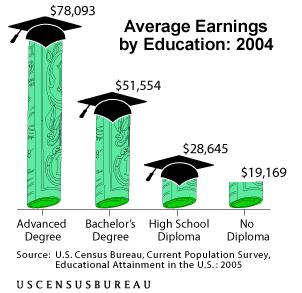
1. The best financial gift to give your children today is education. We are in an information based economy. In biblical times, the inheritance of land was crucial to avoid becoming an indentured servant. But rules that applied to an agricultural society don't apply to our current society. Very few people live on farms these days.

2. Children who inherit large sums of money are less likely to be productive citizens. A book written ten years ago- The Millionaire Next Door- chronicled this in detail. The authors of that book- Stanley & Danko- labeled leaving your children large sums of money economic outpatient care. Stanley & Danko found that the more dollars adult children received, the fewer they accumulated. While those who were given fewer dollars, accumulated more.

The chart above was the conclusion of a recent US Census Bureau study. As you can see, the financial value of education is hard to debate. If a person works 45 years, the differential in pay between a high school graduate and a college graduate is over $1,000,000 during that time span.

My belief is that leaving a monetary inheritance to your children is a good idea only if they have been properly trained to be good stewards of those resources. One of my fundamental beliefs is that we should strive to get the maximum amount resources into the hands of the best stewards. My definition of a steward is someone who manages the resources of another striving to maximize return on those resources. Implicit in this definition is that God is the owner of all resources and we are by nature managers.

The problem is that we almost never see it that way. Money has a way of attaching itself to us like a leech. It tries to reassure us that we deserve it and the more the better. Money causes us to be paranoid as we try to hold on to the illusion that it will somehow come through for us. Money brings baggage. Bruce Springsteen said it well. When he was asked what the difference between making $50 per concert when he was first starting out and $500,000 per concert later on. He said, "When I made $50, I had $50 problems. Now that I make $500,000, I have $500,000 problems."

How much should you leave to your kids? There are no easy answers to that question. Here are some ideas to ponder:
  • Create incentives. Some parents offer to match their children dollar-for-dollar in paying off debt. Other parents match savings or giving. There are some unique ways to encourage the right behavior patterns if you meditate on the end goal.
  • Encourage memories. Family vacations are a terrific gift. Why not enjoy the inheritance with them and plan some special events for those you love?
  • Give inheritance money to a charitable trust or donor advised fund. This could be a great tool for training children to be generous and wise managers of dollars to be used for the benefit of others. It would be a low cost family foundation.
  • Pay for education- not only for your children but also for grandkids. As the chart above shows, it is hard to beat education as an investment in your family's future.

Because I have witnessed so many ruined by inherited wealth, I believe people should be very thoughtful in how they distribute their estates. I believe there is a strong argument to be made for not permanently repealing the estate tax and just having some high exclusion amount- such as $5 million per family. This would protect most family farms and family businesses.

Yes- the estate tax is double taxation. I realize that. Yes- I think the government will be poor managers of your estate. I am in favor of less government any day. But, you can choose to distribute an estate that is over $5 million- which applies to less than 1% of the population- to charity instead of government. If you are in the 99% that has less than $5 million- as most of us are- you should still consider the most effective use of the assets that have been entrusted to you.

The goal of the Christian should always be more generosity to others and frugality towards self. It is easy to theorize about but tougher to practice. But intelligent generosity is needed. Throwing money to poor stewards- whether it is your kids or a charity- is as wasteful as mindless consumption. Excellent stewards who understand the stewardship mandate- Genesis 1:28- deserve the opportunity to do good with greater amounts as they look to grow, expand and cultivate the beauty of God's creation for His glory.

In His Mercy,

Ashley Hodge

Thursday, October 19, 2006

Why I am a biblical progressive


At the heart of stewardship is an understanding of the cultural mandate in Genesis 1:28, "...And God said to them, 'Be fruitful and multiply and fill the earth and subdue it'..."

The story of the Bible can be summarized in three words: Creation; Fall; Redemption. What was formed has been deformed and needs to be reformed. The Scriptures move us from a Garden to a City. The book of Genesis tells us that paradise was originally an undeveloped Garden of Eden. The book of Revelation reveals a new Jerusalem- a developed, perfected city- that comes down from heaven.

As I was eating lunch with my wife- Amy- yesterday, we were discussing that many Christians long for a return to the Garden of Eden. The Amish are an example of this. They shun all forms of technology because they believe these intrusions have destroyed the beautiful things in life. But technology is not bad. It is only been perverted and deformed by sinful uses- pornography, criminal intent, spam, video game addictions, online gambling, etc... Technology can be redeemed and reformed for God's uses and become a beautiful thing- such as sharing pictures with family, access to truth and allowing someone like myself to work from home.

There is nothing wrong with progress. Progress is a great thing. God has called each of us to do the maximum amount of good to the maximum amount of people that our resources will allow. We have been instructed to use money, abilities, time and health to participate in moving God's creation from an undeveloped Garden to a developed City.

In John 20:15 we are told that when Jesus first appeared to Mary Magdalene after His resurrection, Mary mistook Him for the gardener. Is this significant? The Creator moves from a Gardener to a King.

I don't believe as Christians we should make statements like things are worse today than they have ever been. It's an easy statement to make as we look at all the evil and sin in our world. But sin has always been ugly. God and His creation have always been beautiful. Yes, the earth and everything in it will be refined through fire. This will be a time of upheaval that the world has never seen. But God is in control. He knows the date and time that He will bring this to completion. It will be a time of great hope for those who are known by Christ and a time of fear for those who Christ doesn't know- Matthew 7:21-23.

In the meantime, we should hate what is evil and cling to what is good- Romans 12:9. As stewards of God's creation, we should pray and work towards bringing His kingdom on earth as it is in heaven. We should not be wary of words like progress. But we should also not shun truth which is rooted in thousands of years of tradition. We should seek to be a biblical progressive.

For His Glory,

Ashley Hodge


Wednesday, October 11, 2006

Striving For Rest

Hebrews 4:9-11, "So then, there remains a Sabbath rest for the people of God, for whoever has entered God's rest has also rested from his works as God did from his. Let us therefore strive to enter that rest, so that no one may fall by the same sort of disobedience."

Striving to enter rest seems like a paradox. Does it take diligent effort to rest? Yes- in the meaning of this passage we are being taught to strive for holiness that we may prove our faith. We want to enter into God's rest (Heaven) where His beautiful creation will be restored and renovated to perfection. Sin and all the effects of the Fall will be destroyed.

Christians are saved through faith in Christ. It is this faith alone which justifies us before a holy God. But as the Protestant reformers often said, "It is faith alone which justifies, but the faith which justifies is not alone." Good works follow true faith just as Fall follows Summer.

I also believe that we need to strive to obtain proper rest on earth. My thoughts on this issue were sparked by a recent sermon that Neil Tomba at Northwest Bible in Dallas gave. He talked about how our hearts are not quiet before God and that meditation and rest are lost arts. Americans are sleeping less each year. But surprisingly this is not due to working longer hours. The American work week is shrinking. The culprit for a lack of rest is how we invest our leisure time.

I was convicted by the sermon to make some changes in my own life and try to impose those changes on my family. I typically sleep 6-7 hours per day. My work schedule is usually 7am-6pm with some lunch basketball games and work-outs a few days per week. At night, I had fallen into the bad habit of trying to get work done on my laptop computer while my wife and two year old watch television. I would play with my son but my attention was diverted.

This rut led to "working" after the family had gone to sleep. But often this working was not focused because I would keep the television on and watch sports. Or I would surf the internet for news or sports related information. So my new goal is to fast from all technology starting at 6pm every night at least during the week. My wife is in agreement.

I have only done this for a few days, but wow what a difference it has already made. I feel more rested. My mind is sharper throughout the day because I am going to bed earlier. We are spending the time reading at night versus watching television- recording "can't-miss" shows. We often don't realize the noise that we allow into our lives that impedes rest.

The light bulb has been one of the greatest inventions in history. But we have turned it into one of the worst. It has made our lives easier and more productive. But it has also choked out quiet and rest. God designed our bodies to be tired at night- releasing melatonin- and more alert during the day- releasing seratonin. Randy Frazee says we should pattern our lives off of the Hebrew Day Planner. 6am-6pm is designed for productivity/work. 6pm-6am is designed for relationships and rest. Frazee writes about this in length in Making Room For Life.

One of the definitions of rest is: relief or freedom from noise or disturbance. I believe we were designed to have longer periods of this relief and freedom than we often allow ourselves.

Looking Forward to the Eternal Rest,

Ashley Hodge